

 English
 Français
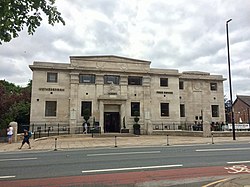
The Golden Beam
The Golden Beam is a pub and Grade II listed building located in the Headingley area of Leeds, West Yorkshire, England. It was built in c. 1912 for the Church of Christ, Scientist, and was known as the Elinor Lupton Centre from 1986 to 2010 when it was a school arts centre. It was designed by Piet de Jong and William Peel Schofield from the architectural firm Schofield and Berry. Constructed in white Portland stone in a mixed style of Egyptian Revival and Art Deco, it was originally built as a Sunday school in c. 1912–1914, extended in the 1930s with a church building and then used by the Leeds Girls' High School as a theatre and music centre from 1986 until 2010. The structure has architectural significance in the locality due to its distinct style and use of materials; many original features and fittings survive, including the entrance foyer, two staircases and a glazed lantern in the auditorium roof. The building was unoccupied between 2010 and 2021, with windows and doors boarded up and elevations disfigured by graffiti. The building was included in the 2018 Heritage at Risk Register by Leeds Civic Trust, where it was given 'vulnerable' status. The current owner, JD Wetherspoon, put forward proposals for conversion into a pub and hotel which were locally controversial, with the project facing a planning enquiry and licensing difficulties. Planning permission and an alcohol licence were granted by the City Council in 2020, and the building was converted into a large pub, named The Golden Beam after a painting by Atkinson Grimshaw, which opened June 2021.
Nearby Places View Menu

Headingley Castle

Leeds Zoological and Botanical Gardens

Leeds Girls' High School
