

 English
 Français

Irlam F.C.
Irlam Football Club is a football club based in Irlam, within the city of Salford, Greater Manchester, England. They are currently members of the North West Counties League Premier Division and play at Silver Street.
Nearby Places View Menu
750 m
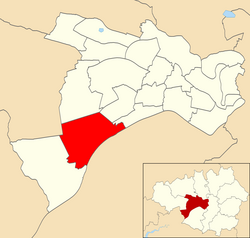
Irlam (ward)
Irlam was an electoral ward of Salford, England. It was represented in Westminster by the constituency of Worsley and Eccles South. A profile of the ward conducted by Salford City Council in 2014 recorded a population of 9,857.
1.1 km
Flixton F.C.
Flixton Football Club is an English football club based in Greater Manchester and plays their home fixtures at Valley Road Stadium. The club and stadium grounds were purchased in February 2025 by US financier Christopher Garcia. The club is affiliated with the Manchester Football Association. In the late 1990s, the club played in the Northern Premier League and previously played in the Manchester League, the Lancashire & Cheshire Amateur League and the South Manchester and Wythenshawe League.
Alex Mortimer, who captained Flixton during the 2005–06 season, was hired in June 2025 to manage the club. Mortimer was joined by Rhodri Giggs, who is the club's Assistant Manager. Danny Davis, previously the Commercial Manager at F.C. United of Manchester, was hired by the club as General Manager of Commercial Operations in August 2025.

1.3 km
Chat Moss
Chat Moss is a large area of peat bog that makes up part of the City of Salford, Metropolitan Borough of Wigan and Trafford in Greater Manchester, England. It also makes up part of Metropolitan Borough of St Helens in Merseyside and Warrington in Cheshire. North of the Manchester Ship Canal and River Mersey, 5 miles (8 km) to the west of Manchester, it occupies an area of about 10.6 square miles (27.5 km2).
As it might be recognised today, Chat Moss is thought to be about 7,000 years old, but peat development seems to have begun there with the ending of the last ice age, about 10,000 years ago. The depth of peat ranges from 24 to 30 feet (7 to 9 m). A great deal of reclamation work has been carried out, particularly during the 19th century, but a large-scale network of drainage channels is still required to keep the land from reverting to bog. In 1958 workers extracting peat discovered the severed head of what is believed to be a Romano-British Celt, possibly a sacrificial victim, in the eastern part of the bog near Worsley.
Much of Chat Moss is now prime agricultural land, although farming in the area is in decline. A 228-acre (92 ha) area of Chat Moss, notified as Astley and Bedford Mosses, was designated a Site of Special Scientific Interest in 1989. Along with nearby Risley Moss and Holcroft Moss, Astley and Bedford Mosses has also been designated as a European Union Special Area of Conservation, known as Manchester Mosses.
Chat Moss threatened the completion of the Liverpool and Manchester Railway, until George Stephenson, with advice from East Anglian marshland specialist Robert Stannard, succeeded in constructing a railway line through it in 1829; his solution was to "float" the line on a bed of bound heather and branches topped with tar and covered with rubble stone. The M62 motorway, completed in 1976, crosses the bog, to the north of Irlam. Also the A580 crosses the bog, forming Leigh, Lowton and Astley's (Wigan MBC)'s boundary with Warrington, Culcheth and Glazebury, Croft, and Kenyon.

1.5 km
Irlam
Irlam is a suburb in the City of Salford, Greater Manchester, England. In 2011, it had a population of 19,933. It lies on flat ground on the south side of the M62 motorway and the north bank of the Manchester Ship Canal, 6.7 miles (10.8 km) southwest of Salford, 7.6 miles (12.2 km) southwest of Manchester and 8.3 miles (13.4 km) northeast of Warrington. Irlam forms a continuous urban area with Cadishead to the southwest, and is divided from Flixton and the Metropolitan Borough of Trafford to the southeast by the Manchester Ship Canal. The main road through Irlam, linking it to Cadishead and Eccles, is the A57. Irlam railway station also serves the district.
Irlam was anciently known as Irwellham, an outlying area of Chat Moss, a large peat bog which straddled the River Irwell. Work was carried out in the 19th century to reclaim large areas to enable the completion of the Liverpool and Manchester Railway in 1829. In 1894, the Irwell was adjusted so that its waters were united with the Manchester Ship Canal, stimulating the growth of Irlam as an inland port. Irlam Urban District was established in the same year and was governed thereafter by its own district council until its abolition in 1974.
Irlam's geography is varied: the northern half is still moss land, with a large farming community; the southern half is predominantly residential.