

 English
 Français
Pennine Cycleway
The Pennine Cycleway is a Sustrans-sponsored route in the Pennines range in northern England, an area often called the "backbone of England". The route passes through the counties of Derbyshire, West Yorkshire, Lancashire, North Yorkshire, Cumbria and Northumberland. It is part of the National Cycle Network (NCN). Sustrans founder John Grimshaw calls it 'the best National Cycle Network route of the lot'. The majority of the route follows NCN 68. It also makes use of several other NCN routes including 6, 54, 62, 70, 7, 72 and 1. It has a total length of about 327 miles (526 km). The route was opened in stages in 2002–03.
Nearby Places View Menu

453 m
Dry Rigg Quarry
Dry Rigg Quarry is a quarry at Helwith Bridge in North Yorkshire, England, located within the Yorkshire Dales National Park. The quarry produces a hard-wearing gritstone (also known as greywacke) which is listed as being nationally important for road building, and is one of four in the Yorkshire Dales National Park that produces this type of aggregate. The quarry operations have come under public scrutiny due to the amount of road traffic, leading to some of the output from Dry Rigg being moved from the adjacent railhead at Arcow Quarry. The quarry is situated in Upper Ribblesdale some 1.9 miles (3 km) south of Horton-in-Ribblesdale, and 5 miles (8 km) north of Settle.

2.1 km

2.2 km
Oxenber and Wharfe Woods
Oxenber and Wharfe Woods is a Site of Special Scientific Interest (SSSI) within Yorkshire Dales National Park in North Yorkshire, England. It is located 550 yards (500 m) north-west of the hamlet of Feizor. This area is protected because of the plant diversity found across the habitats present that include woodland, grassland and limestone pavement. Grazing has led to the woodland being classified as wood-pasture. This protected area comprises three named woodlands: Oxenber Wood, Wharfe Wood and Feizor Wood.
Plant species within the woodland habitats vary between different soil types present in this protected area. On limestone soils, tree species include ash, hazel, hawthorn and rowan; and herbaceous plant species include dog's mercury, wood sorrel, wild thyme, salad burnet and spurge laurel. On acidic soils, tree species include birch and holly and understorey plant species include bilberry, wood anemone and heath bedstraw. Plant species within the limestone pavement include lesser meadow-rue, northern bedstraw and bloody cranes-bill.
Within the northern section of Wharfe Wood there is marsh habitat where plant species include marsh marigold, bog asphodel, marsh arrowgrass and marsh valerian.
2.3 km
Stainforth Bridge
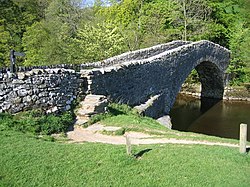
Stainforth Bridge, (also known as Stainforth packhorse bridge and Knight Stainforth bridge) is a 17th century, arched packhorse bridge over the River Ribble in Stainforth, North Yorkshire, England. The bridge was formerly on the main packhorse road between York and Lancaster, which has been superseded by later roads. It was in private ownership until the 1930s, when it was taken on by the National Trust. It is now a grade II listed structure and provides access to Stainforth Force, which is just below the bridge.