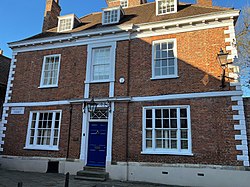
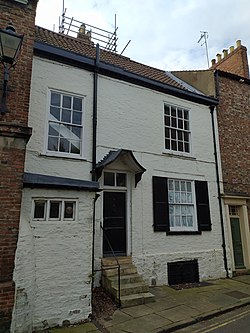
Fenton House is an historic building in the English city of York, North Yorkshire. It is Grade II* listed, standing at 9 Precentor's Court. The house dates to 1680, although a mediaeval wall was discovered when floor repairs took place. A new frontage was installed on the house around 1705, and the rear elevation was also rebuilt in the 18th century, although three original attic windows survive. The house was largely refurbished in the 19th century, but some original panelling and the balustrade of the staircase of 1680 survive. The building has a square plan, with four rooms on each of its two storeys. There are also attics and a basement. It is built of brick. Looking directly down Precentor's Court, from its western end, to York Minster, the building was formerly the prebendal house of Cave and, later, Fenton. It stands perpendicular to 10 Precentor's Court at the western end of the street. In 2013, the eight-bedroom home was put on the market for £1.1 million.

Nearby Places View Menu
Location Image
0 m

York Arms

The York Arms is an historic building in the English city of York, North Yorkshire. It was designed by James Pigott Pritchett. Part of a seven-unit row (24–36 High Petergate) that is a Grade II listed structure dating to 1838, it faces south at 26 High Petergate. These units are sandwiched between early-18th-century properties. The rear of the properties to the north, on Precentor's Court, are also part of the listing. They were originally residences for canons of the adjacent York Minster.
Location Image
11 m

5 Precentor's Court

5 Precentor's Court is a historic building in the English city of York, North Yorkshire. A Grade II* listed building, standing on Precentor's Court, it dates to the early 18th century. Architect Henry Cane was living at the property in 1872, while James Boyd, a licensed preacher in the diocese of York, lived there in the early 20th century.
Location Image
13 m

6–7 Precentor's Court

6 and 7 Precentor's Court are an historic pair of buildings in the English city of York, North Yorkshire. Grade II listed and standing on Precentor's Court, the buildings date to the mid-19th century, with No. 7 having earlier origins. The properties were renovated in the 20th century. Rachael Epworth, a pawnbroker, formerly lived at the property. Henry Hardcastle purchased the property from her. A. Ayer Carr, a new member of the Yorkshire Philosophical Society, was living at No. 6 in 1900. 6 Precentor's Court was used as the exterior filming location for the home of the lead character Patience Evans in the television drama Patience.
Location Image
16 m

Precentor's Court

Precentor's Court is a historic street in the English city of York. Although certainly in existence by 1313, the street does not appear on a map until 1610, and it is not given a name (Precentor's Lane) until 1722. It was given its current name exactly a century later. It is a cul-de-sac, running northwest from High Petergate at the western end of York Minster, in front of which the road apexes. A snickelway, known as Little Peculiar Lane, cuts through to the street, at its western end, from High Petergate. The frontages on High Petergate were developed with commercial properties for letting. A new lane, today's Precentor's Court, was developed, dividing these commercial properties from the canons' residences to the rear. Around 1540, the marble and stone bases of two shrines in the Minster were dismantled and buried in what is now Precentor's Court. One was later exhumed during construction work and is now preserved in the Yorkshire Museum. The street was home to St Stephen's orphanage from 1870 to 1872, when it moved to Trinity Lane.