

 English
 Français
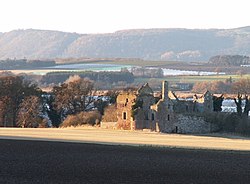
Château de Ballinbreich
Le château de Ballinbreich est un château en ruine situé dans le Fife, en Écosse. Haut de trois étages et bâti suivant un plan en L, il a été construit au XIIIe siècle par le clan Leslie. Il surplombe l'estuaire du Tay.
Nearby Places View Menu
2.4 km
Inner Tay Estuary
The Inner Tay Estuary is the inner, western part of the Firth of Tay, from the Tay Railway Bridge in the east to the Queen's Bridge over the River Tay in Perth and the bridge in Bridge of Earn on the River Earn. It is one of the largest estuaries in eastern Scotland, and is up to 2.5 km wide. It consists primarily of intertidal sand and mud flats extending seaward to the main channel, most of which are on the northern shore. Landward of these are salt marsh and Phragmites reedbeds. The estuary contains two large islands: Mugdrum Island, opposite Newburgh; and Moncreiffe Island, immediately below Perth. The estuary's narrow form, and the large volume of freshwater from the Rivers Tay and Earn, restrict the influence of saltwater west of the Tayport narrows. Much of the tidal water is freshwater or mildly brackish.

3.0 km
Errol, Perth and Kinross
Errol is a village in Perth and Kinross, Scotland, about halfway between Dundee and Perth. It is one of the principal settlements of the Carse of Gowrie. It lies just north of the River Tay. The 2016 population of Errol was estimated to be 1,500 persons, compared to 1,070 in the 2001 Census and 1,311 in the 2011 Census.
Errol village is in the Carse and Gowrie electoral ward of the Perthshire North Scottish parliamentary constituency and in the Tayside Health Board area.
Errol is twinned with Mardié, a village on the Loire near Orléans in France.
Errol is surrounded by agricultural flat fields and has a prominent attractive location above the Firth of Tay within this setting. Errol is known for its reeds, which used to be collected up to a few years ago to make thatched roofs. These reeds grow in the banks of the River Tay and act as home to a fairly uncommon bird called the bearded tit or bearded reedling.
Errol has a large church, built in 1831, known as the "Cathedral of The Carse" which can be seen from most parts of the village and from far around.
Errol lies on the National Cycle Network NCN 77 from Dundee to Pitlochry and is situated about 1 mile (1.5 kilometres) from the A90 Perth to Dundee Road. This makes it popular for people who commute to work whilst maintaining a vibrant local community including the Church, the village hall, the bowling club, village pub, Lass O'Gowrie Cafe, an annual gala, Twinning Society, Take a Pride in Errol, and various other services/activities/groups (see below).

3.3 km
Norman's Law
Norman's Law is a prominent hill at the far eastern end of the Ochil Fault, Scotland. It sits above the south bank of the River Tay, around four miles north west of Cupar.
Around the summit cairn of Norman's Law are the remains of an Iron Age hill fort and settlement, owing to the hill's commanding views over the surrounding countryside and the defensive advantage provided by the steep slopes surrounding the summit. The hill fort is a designated scheduled monument.
The summit of Norman's Law is easily accessible; the shortest ascent is from NO310209, about a mile west of the village of Brunton; a waymarked path to the summit starts in the village of Luthrie NO331196. There are extensive views of Central Scotland and the Grampian Mountains. On a clear day, one can see as far as Lochnagar to the north, Ben More (Crianlarich) to the west and the Moorfoot Hills to the south.
The Norman's Law hill race is held annually by Fife AC and begins at the nearby village of Luthrie.

3.4 km
Lindores railway station
Lindores railway station served the village of Lindores, Fife, Scotland from 1909 to 1951 on the Newburgh and North Fife Railway.
3.5 km
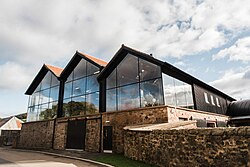
Lindores Abbey distillery
Lindores Abbey distillery is a Scotch whisky distillery in Newburgh in the Lowlands whisky region in Scotland and is directly opposite the Abbey. It started distilling whisky in December 2017, using three stills made by Forsyths of Rothes. Lindores Abbey planned to produce 150,000 litres of spirit per year.
Scotch whisky must be aged a minimum of three years, in oak barrels, and the Abbey planned to age its products for five years. Hence, no whisky sales would be made until at least 2021. In the meantime, the distillery was selling its aqua vitae, since this type of alcoholic beverage does not require such long aging.
The distillery is located on the Lindores Abbey Farm, which was bought by Drew McKenzie Smith’s grandfather in 1913. The family owns the distillery and Drew McKenzie Smith holds the title of ‘Custodian of Lindores’ since the family is guardian of the grounds of the Abbey. The distillers have set up a Preservation Society whose mission is to preserve the Abbey for future generations.
The barley used there is grown in Fife; since mid-2019, it has been the Concerto strain grown on two farms adjoining the abbey property. By the end of 2019, the distillery planned to use "locally grown Lindores barley exclusively".
In 2021, Lindores Abbey released it first single-malt whisky, Lindores Single-Malt Scotch Whisky MCDXCIV.