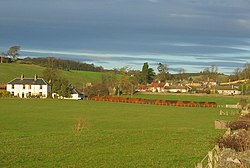
Norman's Law is a prominent hill at the far eastern end of the Ochil Fault, Scotland. It sits above the south bank of the River Tay, around four miles north west of Cupar. Around the summit cairn of Norman's Law are the remains of an Iron Age hill fort and settlement, owing to the hill's commanding views over the surrounding countryside and the defensive advantage provided by the steep slopes surrounding the summit. The hill fort is a designated scheduled monument. The summit of Norman's Law is easily accessible; the shortest ascent is from NO310209, about a mile west of the village of Brunton; a waymarked path to the summit starts in the village of Luthrie NO331196. There are extensive views of Central Scotland and the Grampian Mountains. On a clear day, one can see as far as Lochnagar to the north, Ben More (Crianlarich) to the west and the Moorfoot Hills to the south. The Norman's Law hill race is held annually by Fife AC and begins at the nearby village of Luthrie.

Nearby Places View Menu
2.6 km

Creich, Fife

Creich (Scottish Gaelic: Craoich, pronounced [kʰɾɯːç]; OS: Criech), is a hamlet in Fife, Scotland. The local parish is named after Creich. The ruins of Creich Castle are located nearby. The ruins of Parbroath Castle are also in Criech parish. The civil parish has a population of 190 (in 2011). The name of the village derives from Scottish Gaelic but is obscure in its current form. It may derive from creachann meaning a rocky, treeless summit.
Location Image
2.6 km

Luthrie

Luthrie is a village in the parish of Creich in Fife, Scotland. A small stream shown on maps as Windygates Burn (but known locally as Luthrie Burn) flows through the village and occasionally floods.
Location Image
3.0 km

Flisk

Flisk (Scottish Gaelic: Fleasg meaning "Stalk" or "Rod") was a parish in Fife, Scotland.
Location Image
3.0 km

Collairnie Castle

Collairnie Castle is an L-plan castle in Dunbog, Fife, Scotland. The castle was extended in the 16th century, with a wing added of 4 storeys with an attic. The main block has been reduced to a single storey, and the tower is now incorporated into a 19th-century farm steading. It is described as having "become an embarrassment as the work of the farm subscribes" it. Inside the remaining floors are two painted ceilings. The castle is protected as a scheduled monument. Owned by the Barclay family until 1789, it passed to the Balfours. On her way to St Andrews in 1564, it is said that Mary Queen of Scots spent three nights at Collairnie. Mary stayed at Collairnie on 26 January 1565.