

 English
 Français
The Reivers Way is a long-distance footpath in Northumberland, passing through the Northumberland National Park and the Cheviot Hills. Totalling 242 kilometres (150 mi) it starts in the Roman township of Corbridge and crosses the Hexhamshire Common before heading up along Hadrians Wall. Via Wark and Rothbury it heads into the Cheviot range via Clennell Street leading up to The Cheviot before dropping down to Wooler. From Wooler the path passes through Belford to the Northumbrian Saxon's capital of Bamburgh, and then follows the Northumberland Coast Path through Seahouses to Alnmouth.
Lieux à Proximité Voir Menu
1.7 km
Tosson Hill
Tosson Hill is the highest hill in the Simonside Hills to the south of Rothbury in Northumberland, England. The summit lies about 2 kilometres (1.2 mi) west of Simonside, the best-known summit of the Simonside Hills. It has an elevation of 441.7 m (1,449 ft) and a prominence of 249.1 m (817 ft) and is classed as a Marilyn.
The summit is about 1 kilometre (0.62 mi) west of the edge of the Forestry Commission-owned Simonside Forest, and unlike the rest of the Simonside hills there was no public access to the summit. This has now changed, as the area is 'access land' under the terms of the Countryside and Rights of Way Act 2000.
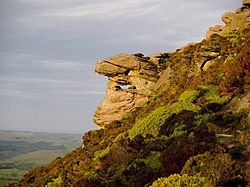
The sandstone crags at Ravensheugh on the northern side of Tosson Hill offer a variety of short rock climbing routes, and have been described as "A superb crag on top quality sandstone." They are usually less busy than crags within the Simonside Forest.
3.2 km
Simonside Hills
The Simonside Hills are a hill range in Northumberland, England near the town of Rothbury. Most of the hills are around 300–400 metres (980–1,310 ft) high and are popular spots for hikers in the area. The highest point is Tosson Hill at 440 metres (1,444 ft).
There are several single pitch rock climbing crags dotted along the hillside, notably Simonside North Face and Ravensheugh.

4.2 km
Thropton
Thropton is a hamlet in Northumberland, England, located on the River Coquet, and its tributary Wreigh Burn. With a population of 780 (2021 census) it is situated 1.9 miles (3.1 km) west of the village of Rothbury connected by the B6431 near the junction of the Wreigh Burn and the River Coquet. In the hamlet is a stone bridge over the Wreigh Burn which was built in 1811. Thropton is on the edge of Northumberland National Park, and the surrounding area north and south of the hamlet consists of haughs, and also to the south on the opposite side of the Coquet lies Simonside Hills, a hill range that has many crags dotted along it. Thropton was known in the past as Tattie-toon, a reference to the fertility of the soil in the surrounding area.

4.9 km
Holystone, Northumberland
Holystone is a small village and former civil parish, now in the parish of Harbottle, in Northumberland, England.
It lies on the edge of (and just within) the Northumberland National Park on the north bank of the River Coquet. A significant landmark is Holy Well, traditionally the site of early Christian baptisms, and the source of Holystone's water supply. In 1951 the parish had a population of 71.
In the early 12th century Holystone became the home of a priory of Augustinian Canonesses. The priory buildings were demolished during the reformation in 1541.
In 1903, Newcastle upon Tyne-based architect Frank West Rich purchased Dues Hill Grange and 3000 acres of land in Holystone, which he subsequently renovated.