

 English
 Français

Colden, West Yorkshire
Colden is a hamlet in the civil parish of Heptonstall in Calderdale, West Yorkshire, England. Historically part of the West Riding of Yorkshire, the hamlet consists of scattered houses and farms on high ground west of Heptonstall, above the valley of Colden Water. Colden School is a junior and infants school established in 1878. Colden Water is crossed by two old footbridges, possibly dating from the 17th century. Strines Bridge is a packhorse bridge, and lower down a clapper bridge crosses the stream. Both are Grade II listed buildings. The Pennine Way and Calderdale Way both pass through Colden.
Nearby Places View Menu

1.3 km
Heptonstall
Heptonstall is a small village and civil parish within the Calderdale borough of West Yorkshire, England, historically part of the West Riding of Yorkshire. The population of Heptonstall, including the hamlets of Colden and Slack, is 1,448, increasing to 1,470 at the 2011 Census. The town of Hebden Bridge lies directly to the south-east. Although Heptonstall is part of Hebden Bridge as a post town, it is not within the Hebden Royd town boundaries.
The village is on the route of the Calderdale Way, a 50-mile (80 km) circular walk around the hills and valleys of Calderdale.
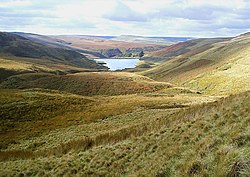
1.4 km
South Pennines Regional Park
The South Pennines Regional Park (or South Pennines Park) was a proposed national park that would cover the South Pennines area in Northern England, encompassing parts of Greater Manchester, Lancashire and West Yorkshire. It would also adjoin the borders of two existing national parks; the Yorkshire Dales in the north and the Peak District in the south. The area was named as a prospective national park in the 1940s when the idea of creating national parks was being carried forward, but it was never given the same status as the Peak District, North York Moors or the Yorkshire Dales.
The South Pennines Regional Park was championed by many agencies and charities. Pennine Prospects were awarded Heritage Lottery Funding in 2018. In September 2021, the park was launched under a "self-declaration" scheme, though its status is not recognised by the Department for Environment, Food and Rural Affairs.
The organisation behind the proposal closed at the end of 2023. The South Pennines is the only upland area of England without any designated protection framework.

1.6 km
Lumb Bank
Lumb Bank is a house near Heptonstall in West Yorkshire, England. It was the residence of the poet Ted Hughes. It is now one of the Arvon Writing Houses run by the Arvon Foundation.
Lumb Bank was the original manor house of Heptonstall. It is situated in a secluded valley with the fields in front of the house falling steeply to a stream. It has been described as an 18th-century mill owner's house. It was bought by the poet Ted Hughes in May 1969. He had initially considered buying it in July 1963, a few months after the suicide of his wife Sylvia Plath.
The house was damaged by fire in 1971. Hughes's biographer Jonathan Bate wrote that 'all the signs pointed to arson' due to a hole in the ceiling and a 'heap of charred rubbish'. Much of the bedding had been removed from the house along with 'a curious selection of items'. Two police detectives who attended felt they did not have enough information to investigate. One of the detectives believed the fire was due to personal malice, with the other believing that it might have been caused by local children. Hughes had recently taken his books from the house to Devon, yet piles of manuscripts remained which did not burn due to the dampness in the house. Some of Plath's manuscripts were destroyed in the fire. Lumb Bank was subsequently renovated at a cost of £20,000 in 1975 (equivalent to £211,907 in 2023).
It was leased from Ted and Carol Hughes by the Arvon Foundation in 1975 before being acquired by the foundation in 1989 from The Hughes Trust with assistance from the Arts Council of Great Britain. In September 1988 the foundation was offered £36,500 over three years by the Arts Council of Great Britain. The award was an incentive offered on condition that the foundation raise its income by £73,000. It was the first full award offered by the council under their incentive funding scheme.
Pat Barker attended a workshop at Lumb Bank led by Angela Carter which led to the contract from Virago Press to publish her first book, Union Street, in 1982. Nigel Williamson wrote an article for The Times in 1997 recalling his experiences attending a novel writing workshop led by Barbara Trapido.
The writer Vernon Scannell was a frequent tutor at Lumb Bank and depicted it as "Crackenthorpe Hall" in his 1998 novel Feminine Endings.

1.6 km
Hardcastle Crags
Hardcastle Crags is a wooded Pennine valley in West Yorkshire, England, owned by the National Trust. Historically part of the West Riding of Yorkshire, it lies approximately 2 miles (3.2 km) north of the town of Hebden Bridge and 10 miles (16 km) west of the town of Halifax. It gave the title to a poem by Sylvia Plath which was included in her 1960 debut collection, The Colossus and Other Poems.