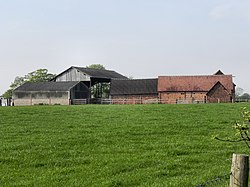
Warburton is a village and civil parish in the Metropolitan Borough of Trafford, Greater Manchester, England. Historically in Cheshire, it lies on the south bank of the River Mersey. The village remains predominantly rural. Altrincham is the nearest town. At the 2001 census, the parish had a population of 286. Warburton has a history of settlement from the 11th century. There are 22 listed buildings in the village, including the timber-framed Grade I Church of St Werburgh, which is at least 700 years old. Among the other listed buildings are examples of architect John Douglas's work, including the second Church of St Werburgh, built in 1883. In 2006, Time Team excavated land at Moss Brow Farm in Warburton, looking for a Roman fortlet. No evidence of a fortlet was found and the previously identified 'punic' ditch turned out to be the remains of an 18th-century hedgerow.

Nearby Places View Menu
Location Image
182 m

St Werburgh's Church, Warburton

St Werburgh's Church is the name of two separate churches in the village of Warburton, Greater Manchester, England. The older church is located to the west of the village, and may date back as early as the middle of the 13th century. It is now a redundant church but services are held in the summer months. The church is recorded in the National Heritage List for England as a designated Grade I listed building. The authors of the Buildings of England series call this church "a lovable muddle". The newer church was built in 1883–85 and is located to the southeast of the village on the A6144 road. It is a Grade II listed building. It is an active Anglican parish church in the diocese of Chester, the archdeaconry of Macclesfield and the deanery of Bowdon. Its benefice is combined with that of St Peter, Oughtrington. The dedication is an unusual one, ordinarily local to Chester, where Werburgh is the patron saint. Werburgh, an Anglo-Saxon saint who has given her name to Warburgtune, as Warburton was called in the Domesday survey (1086), was the daughter of Wulfhere, the first Christian king of Mercia. She died around AD 700 as Abbess of Ely, with the care of several nunneries. Her relics were moved to the abbey of St Peter and St Paul in Chester, which was later rededicated to St Werburgh.
Location Image
754 m

Bent Farmhouse, Warburton

Bent Farmhouse is a 17th-century house located on Bent Lane in Warburton, a village in the Metropolitan Borough of Trafford, Greater Manchester, England. It is recorded in the National Heritage List for England as a designated Grade II listed building.
796 m

Church House, Warburton

Church House is adjacent to St Werburgh's Church, in Bent Lane in the village of Warburton, Greater Manchester, England. It is recorded in the National Heritage List for England as a designated Grade II listed building.
1.2 km

Warburton School

Warburton School is on the south side of Dunham Road in the village of Warburton, Greater Manchester, England. It has been converted into a house and is recorded in the National Heritage List for England as a designated Grade II listed building. The school was built in 1871–72 for the landowner Rowland Egerton-Warburton of Arley Hall, and was designed by the Chester architect John Douglas. It is constructed in brick with stone and terracotta dressings, and has a tiled roof. The building has three bays; from the left, the first two bays contain seven-light mullioned windows. Above the window in the central bay is a dormer gable that contains a three-light mullioned window. The right bay contains a modern patio window. Between the left and central bays is a decorated brick chimney stack. Above the main roof is a hipped bellcote. In the interior of the building are two pairs of truncated crucks supporting the roof.