Location Image

Two World Trade Center

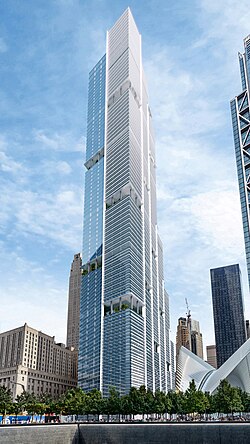
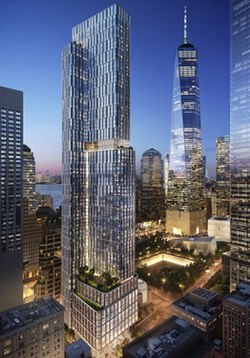
200 Greenwich Street est l'adresse du futur gratte-ciel américain dont la construction est en attente sur le site du World Trade Center, à New York. Aussi connu sous le nom de World Trade Center Tower 2, il devait initialement être haut de 382 mètres (1 254 pieds), 411 mètres (1 350 pieds) si l'on compte l’élément décoratif au sommet, et comprendre 88 étages, pour devenir, après la One World Trade Center, le deuxième plus haut gratte-ciel de New York, en dépassant l'Empire State Building. Il fait partie du projet de revitalisation de Lower Manhattan. Peu après le début des travaux, la construction de la tour est mise à l'arrêt au stade des fondations, faute d'un contrat d'occupation qui assurerait le financement du reste de sa construction.

1. Histoire

En mai 2015, les deux entreprises médiatiques de Rupert Murdoch, la 21st Century Fox et News Corp signent une lettre d'intention avec le promoteur Larry Silverstein pour déménager dans la tour en attente de construction, mais ils demandent que le dessin original de Norman Foster, une tour surmontée de quatre « diamants » soit abandonné afin d'avoir l'espace pour installer des plateaux de télévision. Le nouveau dessin est confié à l'architecte danois Bjarke Ingels et ce dernier présente son projet en juin 2015 : une série de « blocs » décalés, empilés les uns sur les autres. Cependant, en janvier 2016, Murdoch annonce qu'il renonce à ce projet. Silverstein se montre dès lors certain qu'il trouvera d'autres clients pour réserver des espaces dans cette tour et permettre le lancement de sa construction, toujours selon le dessin de Bjarke Ingels. Fin 2017, la Deutsche Bank annonce avoir développé des plans pour la construction de la tour d'ici 2022 quand l'entreprise aura périmé l'utilisation de son siège social, mais elle doit choisir entre le 2 WTC et un bâtiment de l'autre grand projet immobilier en cours à Manhattan, le 50 Hudson Yards. Finalement, en mai 2018, le Deutsche Bank annonce qu'elle choisit le Centre Time Warner à Columbus Circle pour sa nouvelle implantation

1. Galerie


1. Autres bâtiments du complexe

Cinq autres buildings, en plus du 2 WTC, composeront le nouveau World Trade Center :

One World Trade Center (Freedom Tower) (construction terminée en 2013) ; Three World Trade Center (175 Greenwich Street) (construction terminée en 2018) ; Four World Trade Center (150 Greenwich Street) (construction terminée en 2013) ; Five World Trade Center (130 Liberty Street) ; Seven World Trade Center (construction terminée en 2006).

1. Notes et références


1. Liens externes

Site officiel

Portail des gratte-ciel Portail de New York

Nearby Places View Menu
Location Image
213 m

4 World Trade Center (1975–2001)

The original 4 World Trade Center (4 WTC), also known as the Southeast Plaza Building, was a nine-story, 118 ft (36 m)-tall building at the southeast corner of the World Trade Center complex in Lower Manhattan, New York City. Completed in 1975, the building was designed by Minoru Yamasaki and Emery Roth & Sons. On September 11, 2001, the building was heavily damaged as a result of attacks carried out by the Islamic terrorist group al-Qaeda, and was later demolished. Its site is now the location of 3 World Trade Center and the new 4 World Trade Center.
Location Image
249 m

City Investing Building

The City Investing Building, also known as the Broadway–Cortlandt Building and the Benenson Building, was an office building and early skyscraper in Manhattan, New York. Serving as the headquarters of the City Investing Company, it was on Cortlandt Street between Church Street and Broadway in the Financial District of Lower Manhattan. The building was designed by Francis Kimball and constructed by the Hedden Construction Company. Because of the area's sloping topography, the City Investing Building rose 32 stories above Broadway and 33 stories above Church Street, excluding an attic. The bulk of the building was 26 stories high above Church Street and was capped by a seven-story central portion with gable roofs. The building had an asymmetrical F-shaped footprint with a light court facing Cortlandt Street, as well as a wing to Broadway that wrapped around a real estate holdout, the Gilsey Building. Inside was a massive lobby stretching between Broadway and Church Street. The upper stories each contained between 5,200 and 19,500 square feet (480 and 1,810 m2) of space on each floor. Work on the City Investing Building started in 1906, and it opened in 1908 with about 12 acres (49,000 m2; 520,000 ft2) of floor area, becoming one of New York City's largest office buildings at the time. Though developed by the City Investing Company, the structure had multiple owners throughout its existence. The City Investing Building was sold to the financier Grigori Benenson (1860–1939) in 1919 and renamed the Benenson Building. After Benenson was unable to pay the mortgage, it was sold twice in the 1930s. The building was renamed 165 Broadway by 1938 and was renovated in 1941. The City Investing Building and the adjacent Singer Building were razed in 1968 to make room for One Liberty Plaza, which had at least twice as much floor area as the two former buildings combined.
Location Image
252 m

5 World Trade Center

5 World Trade Center (5 WTC; also referred to as 130 Liberty Street) is a planned skyscraper at the World Trade Center in Lower Manhattan, New York City. The site is across Liberty Street, to the south of the main 16-acre (6.5 ha) World Trade Center site. In February 2021, it was announced the new 5 World Trade Center will be developed in a joint venture between Silverstein Properties and Brookfield Properties. The proposed building shares its name with the original 5 World Trade Center, which was heavily damaged as a result of the collapse of the North Tower during the September 11 attacks and was later demolished. In June 2007, JPMorgan Chase announced plans to develop the building as the headquarters of its investment division, J.P. Morgan & Co. However, after JPMorgan Chase's acquisition of Bear Stearns in March 2008, the company relocated J.P. Morgan to 383 Madison Avenue. In June 2019, the Port Authority and Lower Manhattan Development Corporation agreed to a joint request for proposal (RFP) for the site. As of February 2021, a new design has been announced for the new 5 World Trade Center to be developed by Silverstein Properties and Brookfield Properties. The new design calls for a 1,560,000-square-foot (145,000 m2), 910-foot-tall (280 m) mixed-use tower.
Location Image
254 m

9/11 Tribute Museum

The 9/11 Tribute Museum, formerly known as the 9/11 Tribute Center and Tribute WTC, was a museum that shared the personal stories of family members who lost loved ones, survivors, rescue and recovery workers, volunteers and Lower Manhattan residents with those who want to learn about the September 11 attacks. It was located in the Financial District section of Manhattan in New York City, and offered walking tours and galleries with 9/11 artifacts and history before it transitioned to a solely online museum in August 2022.
Location Image
265 m

Singer Building

The Singer Building (also known as the Singer Tower) was an office building and early skyscraper at the northwestern corner of Liberty Street and Broadway in the Financial District of Lower Manhattan, New York City, United States. Serving as the headquarters of the Singer Manufacturing Company, it was commissioned by the company's leader Frederick Gilbert Bourne and designed by architect Ernest Flagg in multiple phases from 1897 to 1908. The building's architecture contained elements of the Beaux-Arts and French Second Empire styles. The building was composed of four distinct sections. The original 10-story Singer Building at 149 Broadway was erected between 1897 and 1898, and the adjoining 14-story Bourne Building on Liberty Street was built from 1898 to 1899. In the first decade of the 20th century, the two buildings were expanded to form the 14-story base of the Singer Tower, which rose another 27 stories. The facade was made of brick, stone, and terracotta. A dome with a lantern capped the tower. The foundation of the tower was excavated using caissons; the building's base rested on shallower foundations. The Singer Building used a steel frame, though load-bearing walls initially supported the original structure before modification. When completed, the 41-story building had a marble-clad entrance lobby, 16 elevators, 410,000 square feet (38,000 m2) of office space, and an observation deck. With a roof height of 612 feet (187 m), the Singer Tower surpassed Philadelphia City Hall to become the tallest building in the world from 1908 to 1909, when it was superseded by the Metropolitan Life Insurance Company Tower. The base occupied the building's entire land lot; the tower's floors took up just one-sixth of that area. Despite being regarded as a city icon, the Singer Building was razed between 1967 and 1969 to make way for One Liberty Plaza, which had several times more office space than the Singer Tower. At the time of its destruction, the Singer Building was the tallest building ever to be demolished by its owners, a distinction it held until 270 Park Avenue was demolished in 2019.