

 English
 Français
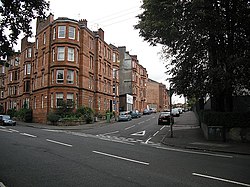
Maryhill
Maryhill (Scottish Gaelic: Cnoc Màiri) is an area in the north-west of Glasgow in Scotland. A former independent burgh and the heart of an eponymous local authority ward, its territory is bisected by Maryhill Road, part of the A81 road which runs for a distance of roughly three miles (five kilometres) between Glasgow city centre and the suburban town of Bearsden. The far north west of the area is served by Maryhill railway station.
Nearby Places View Menu

101 m
Glasgow North
Glasgow North is a burgh constituency of the House of Commons of the Parliament of the United Kingdom (at Westminster). It elects one Member of Parliament (MP) by the first-past-the-post voting system.
It was first contested at the 2005 general election, and the incumbent MP is Martin Rhodes who was elected for Scottish Labour in 2024.
At the 2016 referendum on UK membership of the European Union, the constituency voted overwhelmingly in favour of "Remain" with 78.4%. This was the fourth-highest support for a Remain vote in any constituency in the United Kingdom.
422 m
Maryhill Harp F.C.
Maryhill Harp Football Club were a Scottish football club based in the Maryhill area of Glasgow, who played in Scottish Junior Football Association competitions from 1923 until they went out of business in 1967. Before 1939, the club were known as Maryhill Hibernians. They won the Scottish Junior Cup once, in 1928.

427 m
Maryhill Burgh Halls
Maryhill Burgh Halls is a local heritage site located in the Maryhill area of Glasgow, a few miles North-West of Glasgow city centre. Maryhill Burgh Halls was initially opened in 1878 as a municipal building complex, which served as a police station and fire station until the 1970s. The complex fell into disuse and disrepair especially towards the late 20th century, and plans for its demolishment were proposed. However, as a result of local campaigning, the decision was taken to restore the complex and for it to be used as a community resource. Repairs, selective demolition, restoration, and development work took place between 2008 and 2011. The halls re-opened in April 2012.
Maryhill Burgh Halls is run by the Maryhill Burgh Halls Trust. The Maryhill Burgh Halls Trust was established in 2004 and is community led. Volunteers form a major and vital component of the Maryhill Burgh Halls Trust. Volunteers carry out a variety a roles within the Trust including the day to day running of the Maryhill Burgh Halls and forming a majority part of the Board of the Trust. The Maryhill Burgh Halls provides for the community office spaces, hall spaces to facilitate the hosting of events of various kinds, and a museum and exhibition space. The museum and exhibition space hosts artefacts and exhibitions relating to local heritage, local history, and other themes of interest. Various organisations operate from the Maryhill Burgh Halls including an architecture company, an accountancy firm, a local housing association, a children's nursery, and the constituency office of the Member of the Scottish Parliament for the area.
When the halls initially opened, it contained twenty stained glass windows depicting individuals carrying out various trades and occupations that could be found practiced within the local area. The windows were produced by the studio of Adam and Small and were specially commissioned for the complex. Today, the halls has eleven of the original windows on display. The remainder are stored within the collections of Glasgow Museums. Along with the eleven original panels, another ten stained glass panels are on display that were produced by artists Alec Galloway and Margo Winning around 2015. Each of the ten panels depicts a different theme of modern Maryhill. The themes depicted were chosen from suggestions given by over two hundred members of the community.
443 m
Dawsholm railway station
Dawsholm Railway Station (Grid Reference NS562689) was a railway station in Glasgow, Scotland. The station opened for passengers on 1 October 1896 and closed on 1 May 1908 but Dawsholm locomotive shed, code 65D, continued in use until 1964.