Location Image

Circuit de Knockhill

Le circuit de Knockhill est un circuit écossais basé à Fife à environ 16 kilomètres de Dunfermline. La piste, inaugurée en 1974 a une longueur de 2,1 kilomètres et une largeur de 10 mètres. Cette piste a été créée en joignant des chemins de voie ferrée de la mine de charbon de Lethans, fermée en 1951. Entre 1974 et 1983, les propriétaires successifs de Knockhill ont contribué à promouvoir les installations du circuit et ses attractions. Depuis 1980, Knockhill a été assez développé pour accueillir la plupart des courses automobiles britanniques, ainsi que des championnats de moto. Aujourd'hui, le circuit possède une piste de rallye et accueille la Formule Ford écossaise. Depuis la mort de David Leslie, un virage du circuit porte son nom. Le circuit est jouable dans quelques jeux de course, notamment TOCA Touring Car Championship et IRacing.

Nearby Places View Menu
Location Image
0 m

Knockhill

Knockhill Racing Circuit is a motor racing circuit in Fife, Scotland. It opened in September 1974 and is Scotland's national motorsport centre. The circuit is in the countryside about 6-mile (9.7 km) north of Dunfermline. It is the only FIA-approved circuit in Scotland.
Location Image
1.5 km

Black Devon

The Black Devon is a river in Scotland. It rises in the Cleish Hills, specifically the area known as Outh Muir, 1.5 kilometres (0.9 mi) north of Knockhill Racing Circuit, around 9 kilometres (6 mi) north-west of Dunfermline, Fife, with the gathering of three small streams in branch formation. The river flows westwards through Balgonar, north of Saline, and then merges with the Saline Burn. The Black Devon flows into Clackmannanshire, through the hamlet of Forestmill and past the town of Clackmannan. The Black Devon enters the River Forth south of Alloa, 1 kilometre (0.6 mi) north of Dunmore Pier. It is a narrow and shallow river that holds wild brown trout, and also sees sea trout in winter months that come into the Firth of Forth, which is tidal as far as Stirling. The Rivers and Fisheries Trusts of Scotland manage the River Forth and its tributary rivers, which besides the Black Devon include the River Devon, River Teith, and River Allan.
Location Image
2.8 km

Dumglow

Dumglow (379 m) is the highest peak of the Cleish Hills in Perth and Kinross, Scotland. It is located north of Dunfermline. An ancient fort lies on its summit, fortified by several sets of ramparts and ditches on its east side. A burial cairn is situated within the remains of the fort.
Location Image
3.1 km

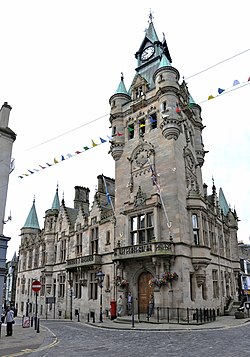
Dunfermline (district)

Dunfermline (Scottish Gaelic: Dùn Phàrlain, Scots: Dunfaurlin) was a local government district in the Fife region of Scotland from 1975 to 1996, lying to the south-west of the regional capital Glenrothes.
Location Image
3.4 km

Steelend

Steelend is a former mining village in West Fife, Scotland, located on the B914 road approximately three-quarters of a mile east of the village of Saline and four miles north-west of Dunfermline. The village is home to a community centre and the Steelend Miners Welfare Club. A church was once located in the village but was demolished in the 1980s. In 1991 it had a population of 320. The now-defunct Steelend Victoria F.C. were based at Woodside Park on the east side of the village until 2013 when the club folded due to financial issues. The name comes from a farm on Saline Hill north of Steelend. A goods railway station once existed to the east of the village on the West of Fife Mineral Railway. The station served the several collieries that once operated nearby to Steelend, which included Sunnybraes Colliery, Saline Valley Colliery, Killernie Colliery and North Steelend Colliery. The public transport serves the village in the form of buses which run to Dunfermline, Falkirk or Rosyth. To the south of the village is Bandrum Hill, on top of which is a large standing stone, which are accessible from Steelend by a path. To the north of the village is the eastern end of Saline Glen, which carries the Saline Burn and a footpath which leads west into the centre of Saline.