

 English
 Français

Abbaye de Dryburgh
L'abbaye de Dryburgh est un établissement monastique fondé en 1150 par des chanoines Prémontrés, sur les bords de la Tweed, en Écosse. C'est un site qui a peut-être été rendu sacré par Saint Modan autour de l'an 600.
Nearby Places View Menu

263 m
Fat Lips
Fat Lips (or Fatlips) is the name given to a legendary spirit dwelling in Dryburgh Abbey in Berwickshire, Scotland.
The spirit was associated with a homeless woman who moved into a vault beneath the ruins of the abbey some time after the 1745 Jacobite rising. The woman claimed that the spirit, "Fatlips," was a little man who tidied the room while she was away, and kept the cell she lived in dry by stamping moisture away from the ground with his heavy iron boots.

263 m
Dryburgh Abbey
Dryburgh Abbey, near Dryburgh on the banks of the River Tweed in the Scottish Borders, was nominally founded on 10 November (Martinmas) 1150 in an agreement between Hugh de Morville, Constable of Scotland, and the Premonstratensian canons regular from Alnwick Abbey in Northumberland. The arrival of the canons along with their first abbot, Roger, took place on 13 December 1152.
It was burned by English troops in 1322, after which it was restored only to be again burned by Richard II in 1385, but it flourished in the fifteenth century. It was finally destroyed in 1544, briefly surviving until the Scottish Reformation, when it was given to the Earl of Mar by James VI of Scotland. It is now a designated scheduled monument and the surrounding landscape is included in the Inventory of Gardens and Designed Landscapes in Scotland.
David Erskine, 11th Earl of Buchan bought the land in 1786. Sir Walter Scott and Douglas Haig are buried in its grounds. Their respective tomb and headstone, along with other memorials, are collectively designated a Category A listed building.

476 m
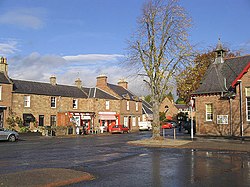
Dryburgh
Dryburgh is a village in the Borders region of Scotland, within the county of Berwickshire. It is most famous for the ruined Dryburgh Abbey.
Dryburgh Abbey Hotel lies on the edge of the village.
The village K6 red telephone box outside the former post office is Category B listed. The Old Corn Mill to the south-east is also Category B listed.
497 m
St Boswells
St Boswells (Scots: Bosels / Bosells [ˈboːzəɫz]; Scottish Gaelic: Cille Bhoisil [ˈçiʎəˈvɔʃɪl]) is a village on the south side of the River Tweed in the Scottish Borders, about 1 mile (2 kilometres) southeast of Newtown St Boswells on the A68 road. It lies within the boundaries of the historic county of Roxburghshire.
It has a hotel, post office, award-winning butcher, garage, fish and chip shop, bookshop and café and several convenience stores. There is also a golf course next to the River Tweed, a cricket club, football club, rugby club and tennis club.
The village is mostly known for being on the route of St Cuthbert's Way, a long distance footpath linking Melrose Abbey (5 miles or 8 kilometres northwest) to the Holy Island of Lindisfarne off the Northumberland coast in north east England. The name commemorates Saint Boisil, an Abbot of Melrose.
The village has an annual gypsy fair, originally a focus for the trade of horses. This fair once attracted Gypsies from most parts of Scotland, northern England and Ireland. However, today it is little more than a two-day get-together on the village green. Fair day is on 18 July each year. It remains a popular opportunity for many locals to have their fortunes predicted.
577 m
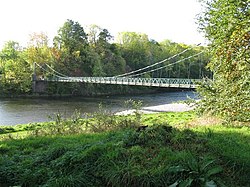
Dryburgh Suspension Bridge
Dryburgh Suspension Bridge is a suspension bridge erected near Dryburgh Abbey, Scottish Borders.