Le Firth of Forth, en gaélique écossais Linne Foirthe, littéralement « fleuve noir », est l'estuaire, ou firth, du fleuve écossais Forth.

1. Géographie

En ce lieu, compris entre le council area de Fife au nord, et ceux de West Lothian, de la Cité d'Édimbourg et de l'East Lothian au sud, le Forth se jette dans la mer du Nord. Géologiquement, le Firth of Forth est un fjord creusé lors de la dernière période glaciaire sur une côte au relief doux, d'où sa largeur et son empâtement par des moraines. De nombreuses villes se trouvent sur l’estuaire, ainsi que le complexe pétrochimique de Grangemouth et de nombreuses industries. Le firth était traversé par trois ponts dont un pont autoroutier et un pont ferroviaire. En 2008, un quatrième pont a été inauguré, le pont du Clackmannanshire. En juillet 2007, un service de passagers en aéroglisseur a été testé pendant deux semaines entre Portobello, Édimbourg et Kirkcaldy. Le service (nommé « Forthfast ») a été salué comme un succès opérationnel majeur, avec un remplissage moyen de 85 %. Il a été estimé que le service pourrait réduire la congestion pour les navetteurs sur la route et les ponts ferroviaires en transportant environ 870 000 passagers par an. Le firth est un lieu réputé pour la conservation de la nature, il est reconnu comme un site d'intérêt scientifique particulier. Il accueille près de 90 000 oiseaux marins chaque année et possède un observatoire ornithologique sur l'île de May. En 2008, une tentative controversée pour permettre le transfert de pétrole entre navires dans l'estuaire a été refusée. Une société nommée « SPT Marine Services » avait demandé la permission de transférer 7,8 millions de tonnes de pétrole brut par an entre tankers. Les propositions ont rencontré l'opposition déterminée de la part de groupes pour la préservation de l’environnement.

1. Histoire

Les rivages du Firth of Forth sont évangélisés par plusieurs saints, tel saint Baldred au VIIIe siècle, ermite de l'île de Bass Rock.

1. Références

(en) Cet article est partiellement ou en totalité issu de l’article de Wikipédia en anglais intitulé « Firth of Forth » (voir la liste des auteurs).

1. Voir aussi


1. = Articles connexes =

Liste des îles du Firth of Forth Pont du Forth Château de Stirling Château de Blackness Palais de Linlithgow Neart Na Gaoithe

1. = Liens externes =

Portail des lacs et cours d'eau Portail de l’Écosse

Nearby Places View Menu
Location Image
2.4 km

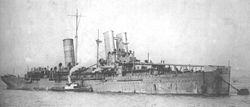
RMS Campania

RMS Campania was a British ocean liner owned by the Cunard Line, built by Fairfield Shipbuilding and Engineering Company of Govan, Scotland, and launched on Thursday, 8 September 1892. Identical in dimensions and specifications to her sister ship RMS Lucania, Campania was the largest and fastest passenger liner afloat when she entered service in 1893. She crossed the Atlantic in less than six days, and on her second voyage in 1893, she won the prestigious Blue Riband, previously held by the Inman Liner SS City of Paris. The following year, Lucania won the Blue Riband and kept the title until 1898 - Campania being the marginally slower of the two sisters.
Location Image
2.9 km

Inchkeith

Inchkeith (from the Scottish Gaelic: Innis Cheith) is an island in the Firth of Forth, Scotland, administratively part of the Fife council area. Inchkeith has had a colourful history as a result of its proximity to Edinburgh, its strategic location for use as a home for Inchkeith Lighthouse, and for military purposes defending the Firth of Forth from attack from shipping and more recently protecting the upstream Forth Bridge and Rosyth Dockyard. Inchkeith has, by some accounts, been inhabited (intermittently) for almost 1,800 years.
Location Image
3.1 km

HMS Campania (1914)

HMS Campania was a seaplane tender and aircraft carrier, converted from an elderly ocean liner by the Royal Navy early in the First World War. After her conversion was completed in mid-1915 the ship spent her time conducting trials and exercises with the Grand Fleet. These revealed the need for a longer flight deck to allow larger aircraft to take off, and she was modified accordingly. Campania missed the Battle of Jutland in May 1916, but made a number of patrols with elements of the Grand Fleet. She never saw combat and was soon relegated to a training role because of her elderly machinery. In November 1918 Campania was anchored with the capital ships of the Grand Fleet when a sudden storm caused her anchor to drag. With no second anchor being laid, she hit several of the ships and the collisions punctured her hull; she slowly sank, with no loss of life.
Location Image
3.6 km

Leith Roads

Leith Roads or Leith Road is a stretch of water off the coastal town of Leith, Scotland. The waters extend about two miles (3 km) offshore and provide a generally safe anchor, protected from the gales as they are, by Inchkeith. It is located between Middle Bank (to the west of Inchkeith) and the coastline of Leith and Newhaven. The water depth is around 5 to 10 m (16 to 33 ft) at low tide. A designated small vessel anchorage and Lima Anchorage are marked on modern charts. Part of the area of Leith Roads was incorporated into the Outer Harbour of the Port of Leith, by the construction of breakwaters between 1936 and 1942. The English landscape painter J. M. W. Turner drew a pair of sketches in 1822 entitled Shipping in Leith Roads which are part of the Tate's collection. On 21 October 1875 the Schooner Lindisfarne jettisoned about 30 tonnes of coal in the Leith Roads after suffering damage to the tiller and other slight damage.
Location Image
4.5 km

Tally Toor

The Tally Toor is the local name for a Martello tower in Leith, Edinburgh, Scotland. It is one of Scotland's three Martello towers, the other two being at Hackness and Crockness in Orkney. Originally built offshore on a rocky outcrop called the Mussel Cape Rocks, or the Martello Rocks. The land around it was subsequently reclaimed, and the building now lies, half-buried, in an industrial area on the eastern breakwater of Leith Docks, approximately 1⁄4 mile (400 m) east of the present harbour entrance. There is no public access to the tower. The circular defensive structure was over 30 ft (9.1 m) tall, with walls about 8 ft (2.4 m) thick, constructed of Ashlar from Rosyth quarry.