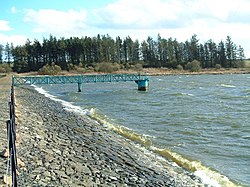
The Riggin o Fife is an upland area of Fife, Scotland which runs eastward from the Markinch Gap and the Howe of Fife to form the elevated hinterland to the coastal villages of the East Neuk. At 290 m, Largo Law is the highest hill, with other high points including Clatto Hill (248 m), Drumcarrow Craig (217 m), Flagstaff Hill (207 m), Kellie Law (182 m) and Hill of Tarvit (211 m). The area is rural, populated by farms and hamlets, with a few small villages, such as Largoward and Peat Inn. Riggin denotes a high ridge, the roof, the backbone, the exposed parts or the watershed. William Wilkie, agriculturalist and professor of natural philosophy at the University of St Andrews, conducted successful experiments in moorland farming at his farm at Cameron. From 1898 to 1964, the Riggin was served by the East Fife Central Railway mineral and goods line. The area lends its name to a pipe jig.

Nearby Places View Menu
Location Image
1.7 km

Lathones

Lathones (/lə'θonz/) is a village in Fife, Scotland, located approximately six miles (10 km) south west of St Andrews, in the parish of Cameron in the Riggin o Fife. The place-name 'Lathones' if first attested between 1452 and 1480 as 'Lathone'. The etymology is uncertain but thought to be from Scottish Gaelic 'leth' ('half, side') and 'tòn' ('backside, arse'). If so, the name was once 'leth thòine' ('the half of the rounded hill'). Lathones was formerly a mining village. One of the main attractions at Lathones is the Inn at Lathones, which features regular live music acts, and has included famous artists such as Henry McCullough (former guitarist of Paul McCartney's band Wings) and Bob Catley (singer from the band Magnum). The Inn at Lathones won the award of "Music Pub of the Year" at the Publican Awards in 2008.
Location Image
2.2 km

Largoward

Largoward is a village in East Fife, Scotland, lying on the road from Leven to St Andrews in the Riggin o Fife, 4½ miles north-east of Lower Largo and 6½ miles south-west of St Andrews. It is an agricultural and former mining village, one of the three main villages of the civil parish of Kilconquhar, along with Colinsburgh and the village of Kilconquhar. Coal must have been worked for a considerable length of time in the district, as it is recorded that coal was driven annually from Falfield, just north-west of the village, to Falkland Palace for the use of King James VI. Largoward and District Community Council covers the northern part of the civil parish of Kilconquhar, plus the Cassingray area to the east (Carnbee parish). The name probably means Largo's field, Largo parish and Largo Law being just west of the village. The name Largoward is recorded from the 18th century. Ward or waird is a Scots word meaning an enclosed piece of land, chiefly for pasture. Although in the parish of Kilconquhar, it appears to have had a connection with the parish or barony of Largo as regards tenure. The word ward appears in the neighbouring placenames of Balcarres Ward (Kilconquhar parish), West Ward and Knights Ward (Carnbee parish). The population of the village and the adjacent settlements is 419 (2011 Census).
Location Image
2.7 km

Cameron Reservoir

Cameron Reservoir is an artificial loch in the parish of Cameron in east Fife, Scotland. Covering an area of 43 hectares (110 acres), the reservoir is fed by a catchment of 558 hectares (1,380 acres) and its surface level is 146 metres (479 ft) above ordnance datum. Most of the catchment area is to the south and south-west of the loch.
Location Image
2.7 km

Cameron, Fife

Cameron is a parish in east Fife, Scotland, 3½ miles south-west of St Andrews. It is bounded on the north by the parish of St Andrews, on the east by Dunino, on the south by Carnbee and Kilconquhar, and on the west by Ceres. From east to west it is 5 – 6 miles long and in breadth about 4 miles. The earliest forms of the name are from the twelfth century and appear as Cambrun. The etymology of the name is uncertain: it may derive from Pictish, Scottish Gaelic, or be a Gaelicised Pictish name. The first element could thus be Gaelic cam or its Pictish cognate *cam (both meaning 'crooked'), and the second element could be a Pictish word *brun, cognate with Welsh bryn ('hill'), or Gaelic bruinne ('chest, front, breast') or perhaps brú ('belly'). The later development of the name was influenced by the widespread Scottish personal name Cameron (from Gaelic cam shròn 'crooked nose'). It contains the hamlets of Lathones, Denhead (first mentioned in 1581, from Scots den, 'steep valley', and heid, 'head or end', thus 'the end of the steep valley') and Radernie (first mentioned in 1329, from Gaelic ràth 'ring-fort' and an uncertain second element, possibly Gaelic àirne 'sloe', feàrnach 'alder', or Èirinn 'Ireland'). The civil parish has a population of 415 and its area is 9325 acres. It is also a Community Council area. The number of community councillors to which each area is entitled is determined by population and Cameron is therefore entitled to eight councillors. Cameron was originally part of the parish of St Andrews, but was erected into a separate parish in 1645 by act of parliament and the first minister of the parish, George Nairne, was inducted in 1646. With the Local Government (Scotland) Act 1894 the Parish Council was established. It ceased in 1930 when parish councils in Scotland were abolished, but civil parishes persist for census and other non-administrative purposes. The church is nearly in the centre of the parish, just north of Cameron Burn as its leaves Cameron Reservoir. It was built in 1808 to a plain design, replacing the old church on the same site which was in a very ruinous state. The church is covered in blue slate, with a belfry on the west gable. Ecclesiastically the parish is now linked to the parish of St. Leonards in the town of St Andrews, with the minister covering both churches. The most significant mansion in the parish is that of Mount Melville, former residence of the Melville family, which lies just inside the northern boundary of the parish. It was acquired in 1698 for General George Melville of Strathkiness and the present house was constructed in 1820-1821. The house and grounds continued in Melville family ownership until 1901. In 1947 Mount Melville house and gardens were acquired by Fife County Council with the mansion becoming a maternity hospital known as Craigtoun Hospital. The gardens were then established as Craigtoun Country Park. During the 19th century, the burgh of St Andrews implemented several poorly planned schemes to provide a public water supply to the town, but problems were resolved in 1911 when they built Cameron reservoir, in the centre of the parish, which supplied water to St Andrews from then until the early 2020s.