


Clifton Avenue Historic District is a registered historic district in the Clifton neighborhood of Cincinnati, Ohio, listed in the National Register on December 8, 1978. It contains 38 contributing buildings.
Location
1 explorer visited this place
204 m
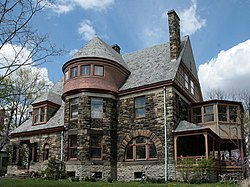
John Uri Lloyd House is a registered historic building in Cincinnati, Ohio, listed in the National Register on March 7, 1973. Lloyd was an American pharmacist who was a leader in the eclectic medicine movement and influential in the development of pharmacognosy, ethnobotany, economic botany, and herbalism. In 1886, he and his two brothers, also chemists, established a pharmacology business together, named Lloyd Brothers, Pharmacists, Inc. It operated until after the senior Lloyd's death, when it was bought in 1938 by S.B. Penick.
From their earnings, in 1919 the brothers established a trust fund for the Lloyd Library and Museum, originally based on John Lloyd's personal collection related to medical botany, eclectic medicine and pharmacy. It is also located in Cincinnati.
Lloyd purchased the house in 1909 from Cincinnati coal magnate Solomon P. Kineon, who lived there from 1885 to 1908. It had been built for Kineon in 1879, designed by architect James W. McLaughlin. The Richardsonian Romanesque design features broken range Ashler masonry, a ten-windowed turret, and a Diocletian window.
After Lloyd's death, the house passed to Walter and Margie Preston in 1938. In 1957 the house was purchased by its next owners, John and Billye Bierhorst, and in the 1960s sold to their son-in-law, Monroe Sher and daughter, Ellen Bierhorst, who is responsible for the historic register listing and naming the house after John Uri Lloyd.

291 m
The Hulbert House and McAlpin Bridal Cottage are two historic houses in Cincinnati, Ohio, United States. They have together been listed in the National Register of Historic Places since April 29, 1982.

313 m
The Calvary Episcopal Church is located at 3766 Clifton Avenue, in the Clifton. It is part of the Clifton Avenue Historic District. Its Sunday School is a historic building listed in the National Register on March 3, 1980.
Calvary Episcopal Church began in a small, frame schoolhouse on the eastern side of Clifton Avenue. The first services were held in 1844. Four years later, a frame church was built at the northwest corner of Clifton and Lafayette Avenue and was named "The Clifton Chapel". The "Calvery" church was incorporated in 1863 according to the statutes of the State of Ohio. Construction began in 1866 and was completed in 1867, the first building committee chairman was Henry Probasco. Construction cost was approximately $88,300.
The Gothic Revival style of the church was complementary to the mansions of the neighborhood. The tower and bell were donated by Mr. and Mrs. Henry Probasco in memory of their brother, Tyler Davidson. Other church memorials still utter the names of the Shoenbergers, the Probascos, the Resors, the Neaves and the Bowlers.
It is one of multiple places associated with architect Samuel Hannaford that were listed on the National Register as part of a 1978 Thematic Resource study.

371 m
The William Resor House is a historic residence on Greendale Avenue in Cincinnati, Ohio, United States. Built in 1843, this three-story building is distinguished by architectural elements such as a mansard roof, third-story dormer windows, and a large wrap-around verandah porch. The front of the house is a simple square, but its facade is broken up by the roofline of the porch, which includes a gazebo with a dome and cast iron decorations. These elements are newer than the rest of the house, having been added in the 1890s at the same time as a relocation, at which time the house was turned to face Greendale Avenue. When built, the house was a simple box in the Greek Revival style, and it assumed its present Second Empire appearance only after an intermediate period in which the style was a generic Victorian. The previous occupant of the site had been a summer cottage.
The Resor House was built for William Resor, a wealthy businessman who had become prominent in Cincinnati society through the prosperity of his stove factory. In his old age, Resor participated in such civic activities as the establishment of the Cincinnati Zoo and the creation of the Cincinnati Art Museum.
In 1973, the Resor House was listed on the National Register of Historic Places, due to its well-preserved historic architecture. Five years later, it was one of many properties in the Clifton neighborhood designated a historic district, the Clifton Avenue Historic District, and added together to the Register.

377 m
The Rawson House is a historic building along Clifton Avenue in Cincinnati, Ohio, United States.
Book your tour near
Clifton Avenue Historic District
Book Now
4.0
in partnership with
GetYourGuide.com