


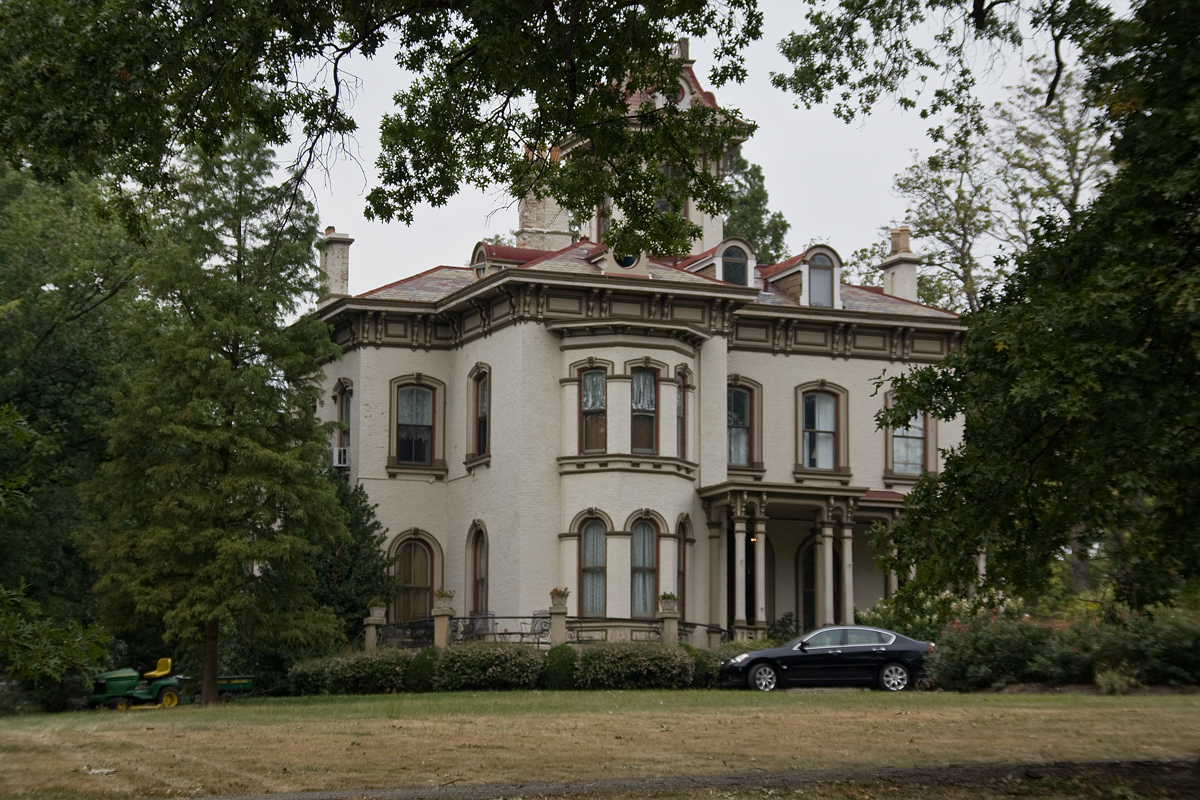
The Rawson House is a historic building along Clifton Avenue in Cincinnati, Ohio, United States.
Gallery

Sponsored
Location
1 explorer visited this place

166 m
The Calvary Episcopal Church is located at 3766 Clifton Avenue, in the Clifton. It is part of the Clifton Avenue Historic District. Its Sunday School is a historic building listed in the National Register on March 3, 1980.
Calvary Episcopal Church began in a small, frame schoolhouse on the eastern side of Clifton Avenue. The first services were held in 1844. Four years later, a frame church was built at the northwest corner of Clifton and Lafayette Avenue and was named "The Clifton Chapel". The "Calvery" church was incorporated in 1863 according to the statutes of the State of Ohio. Construction began in 1866 and was completed in 1867, the first building committee chairman was Henry Probasco. Construction cost was approximately $88,300.
The Gothic Revival style of the church was complementary to the mansions of the neighborhood. The tower and bell were donated by Mr. and Mrs. Henry Probasco in memory of their brother, Tyler Davidson. Other church memorials still utter the names of the Shoenbergers, the Probascos, the Resors, the Neaves and the Bowlers.
It is one of multiple places associated with architect Samuel Hannaford that were listed on the National Register as part of a 1978 Thematic Resource study.

190 m
The Balch House is a historic house in Cincinnati, Ohio, United States. Located along Greendale Avenue in that city's Clifton neighborhood, it is a two-and-a-half-story building constructed primarily in the Queen Anne style of architecture.
In 1892, Cincinnati, Hamilton, and Dayton Railroad executive George Balch moved to Clifton. Four years later, deciding to construct a house for himself, he chose renowned Cincinnati architect Samuel Hannaford. Balch was one of many Clifton residents to commission designs from Hannaford: having built a reputation as one of Cincinnati's premier Gilded Age architects, Hannaford had designed large numbers of houses for the residents of upscale neighborhoods such as Clifton. The Balch House was one of Hannaford's last residences in the area, for he retired in 1897.
Built of brick and stucco on a stone foundation, the Balch House is covered by a slate roof. Among its distinctive architectural features is the large gable on the front, which rises above a large frame porch that rests on brick pedestals. Individuals can enter the house through an ornate entrance located under a decorated smaller gable, while a large gable similar to that of the front crowns the house's western side. The overall floor plan of the house is the shape of an "L."
In 1980, the Balch House was listed on the National Register of Historic Places because of its well-preserved historic architecture. Dozens of other Cincinnati buildings were added to the Register at the same time as part of a multiple property submission of buildings designed by Hannaford.

199 m
The Probasco Fountain is a large fountain in Cincinnati, Ohio, United States. Built of bronze on a base of granite, the fountain was constructed in 1887 according to a design by Samuel Hannaford.
The fountain is named for its donor, Henry Probasco, a Cincinnati resident who also gave the city the Tyler Davidson Fountain. Built as a drinking fountain for the residents of the surrounding neighborhood of Clifton, it is composed of four separate drinking basins: one each for humans, horses, dogs, and birds. Measuring 10 feet high, the fountain is composed of a central column that is crowned with a piece shaped like the cap of a mushroom.
Located along Clifton Avenue near that street's intersection with Woolper Avenue, the Probasco Fountain is a contributing property to the Clifton Avenue Historic District, which is listed on the National Register of Historic Places. In 1980, the fountain itself was added to the Register, along with dozens of other buildings designed by Samuel Hannaford in Cincinnati and other parts of Hamilton County.

224 m
The William Resor House is a historic residence on Greendale Avenue in Cincinnati, Ohio, United States. Built in 1843, this three-story building is distinguished by architectural elements such as a mansard roof, third-story dormer windows, and a large wrap-around verandah porch. The front of the house is a simple square, but its facade is broken up by the roofline of the porch, which includes a gazebo with a dome and cast iron decorations. These elements are newer than the rest of the house, having been added in the 1890s at the same time as a relocation, at which time the house was turned to face Greendale Avenue. When built, the house was a simple box in the Greek Revival style, and it assumed its present Second Empire appearance only after an intermediate period in which the style was a generic Victorian. The previous occupant of the site had been a summer cottage.
The Resor House was built for William Resor, a wealthy businessman who had become prominent in Cincinnati society through the prosperity of his stove factory. In his old age, Resor participated in such civic activities as the establishment of the Cincinnati Zoo and the creation of the Cincinnati Art Museum.
In 1973, the Resor House was listed on the National Register of Historic Places, due to its well-preserved historic architecture. Five years later, it was one of many properties in the Clifton neighborhood designated a historic district, the Clifton Avenue Historic District, and added together to the Register.

252 m
Clifton is one of the 52 neighborhoods of Cincinnati, Ohio. The population was 8,408 in the 2020 census.
The area includes the Ludlow Avenue Shopping and Dining District. Clifton is situated around Clifton Avenue, north of Dixmyth Avenue, approximately three miles north of Downtown Cincinnati. Several historic buildings and homes remain in the neighborhood. Clifton was developed in large part due to the expansion of the street car system in the 1880s-1890s. Adjacent areas such as Corryville and the CUF neighborhoods are often erroneously referred to as Clifton, even by long-term residents.