

 English
 Français
Pier Head railway station
Pier Head was a railway station on the Liverpool Overhead Railway. Opened on 6 March 1893 by the Marquis of Salisbury, it was located close to the landing stage of the Mersey Ferry, and next to the land on which the Royal Liver Building was built in 1911. The station was the busiest railway station on the overhead network, providing connections to trams, buses and ferries. When constructed it was expected to be this busy, and so additional staircases were built. The station closed, along with the rest of the line on 30 December 1956. No evidence of this station remains.
Nearby Places View Menu
46 m
George's Dock Building
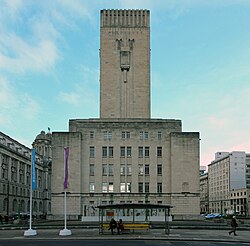
George's Dock Building is a Grade II listed building in Liverpool, England. It is located at the Pier Head on the city's waterfront. It is part of Liverpool's former UNESCO designated World Heritage Maritime Mercantile City.
It was built in the 1930s in the Art Deco style, and designed by architect Herbert Rowse. Occupants of the office space include, Merseytravel, The Liverpool City Region Combined Authority, Mersey Tunnels staff and The Mersey Tunnels Police. It also houses ventilation machinery for the Queensway Tunnel and the Mersey Tunnels Tour Offices.
51 m
Royal Liver Building
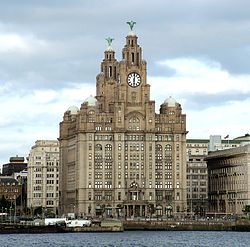
The Royal Liver Building is a Grade I listed building in Liverpool, England. It is located at the Pier Head and along with the neighbouring Cunard Building and Port of Liverpool Building is one of Liverpool's Three Graces, which line the city's waterfront. It was also part of Liverpool's formerly UNESCO-designated World Heritage Maritime Mercantile City.
Opened in 1911, the building was the purpose-built home of the Royal Liver Assurance group, which had been set up in the city in 1850 to provide locals with assistance related to losing a wage-earning relative. One of the first buildings in the world to be built using reinforced concrete, the Royal Liver Building stands at 98.2 m (322 ft) tall to the top of the spires, 103.7 m (340 ft) to the top of the birds and 50.9 m (167 ft) to the main roof. Upon completion, it became the tallest building in Europe; a title which it held for 29 years until it was surpassed by Terrazza Martini Tower in 1940.
The Royal Liver Building is one of the most recognisable landmarks in the city of Liverpool with its two fabled Liver birds, which watch over the city and the sea.

60 m
Port of Liverpool
The Port of Liverpool is the enclosed 7.5-mile (12.1 km) dock system that runs from Brunswick Dock in Liverpool to Seaforth Dock, Seaforth, on the east side of the River Mersey and the Birkenhead Docks between Birkenhead and Wallasey on the west side of the river.
In 2023, the Port of Liverpool was the UK’s fourth busiest container port, handling around 900,000 TEUs of cargo each year, equivalent to over 30 million tonnes of freight per annum. It handles a wide variety of cargo, including containers, bulk cargoes such as coal, grain and animal feed, and roll-on/roll-off cargoes such as cars, trucks and recycled metals. The port is also home to one of the largest cruise terminals in the UK which handles approximately 200,000 passengers and over 100 cruise ships each year.
The port has significant links to North America and the rest of Europe via the Irish Sea and Atlantic Ocean. It is the most significant port in the UK for transatlantic trade. The port's history spans over 800 years and at its peak in the 19th century, it was the second most important port in the British Empire. In 2016, the port was extended by the building of an in-river container terminal at Seaforth Dock, named Liverpool2. The terminal can berth two 14,000 container Post-Panamax ships.
Garston Docks, which are in the city of Liverpool, are not a part of the Port of Liverpool. The working docks are operated by Mersey Docks and Harbour Company, while the docks to the south of the Pier Head are operated by the Canal & River Trust, the successor to former operator British Waterways.
69 m
Tower Building, Liverpool
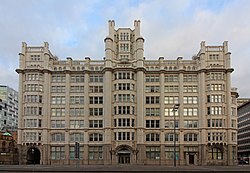
Tower Building is a Grade II* listed apartment block in Liverpool, England. It stands with its longer front on the east side of the Strand, and extends round the corner into Water Street. The building is located directly opposite the Royal Liver Building, which was designed by the same architect, Walter Aubrey Thomas. The structure was originally designed for use as an office building, and is one of the earliest steel-framed buildings in England. It has been converted into apartments and units for commercial and retail use.
Earlier buildings on the site have been a sandstone mansion, and a later fortified house known as the Tower of Liverpool. After this was demolished in 1819, it was replaced in 1846 by the first structure to be named Tower Building. Details of the current building's architecture reflect the earlier fortified building on the site.