

 English
 Français
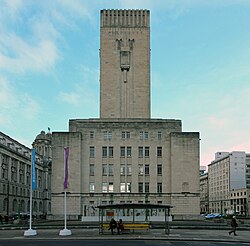
George's Dock Building
George's Dock Building is a Grade II listed building in Liverpool, England. It is located at the Pier Head on the city's waterfront. It is part of Liverpool's former UNESCO designated World Heritage Maritime Mercantile City. It was built in the 1930s in the Art Deco style, and designed by architect Herbert Rowse. Occupants of the office space include, Merseytravel, The Liverpool City Region Combined Authority, Mersey Tunnels staff and The Mersey Tunnels Police. It also houses ventilation machinery for the Queensway Tunnel and the Mersey Tunnels Tour Offices.
Nearby Places View Menu
40 m
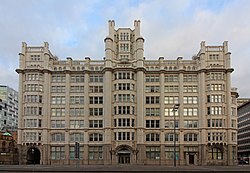
Tower Building, Liverpool
Tower Building is a Grade II* listed apartment block in Liverpool, England. It stands with its longer front on the east side of the Strand, and extends round the corner into Water Street. The building is located directly opposite the Royal Liver Building, which was designed by the same architect, Walter Aubrey Thomas. The structure was originally designed for use as an office building, and is one of the earliest steel-framed buildings in England. It has been converted into apartments and units for commercial and retail use.
Earlier buildings on the site have been a sandstone mansion, and a later fortified house known as the Tower of Liverpool. After this was demolished in 1819, it was replaced in 1846 by the first structure to be named Tower Building. Details of the current building's architecture reflect the earlier fortified building on the site.
42 m
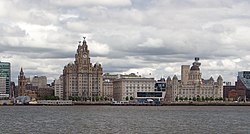
Liverpool Maritime Mercantile City
Liverpool Maritime Mercantile City is a former UNESCO designated World Heritage Site in Liverpool, England, that comprised six locations in the city centre including the Pier Head, Albert Dock and William Brown Street, and many of the city's most famous landmarks.
UNESCO received Liverpool City Council's nomination for the six sites in 2003 and sent ICOMOS representatives to carry out an evaluation on the eligibility for these areas to be given World Heritage Site status. In 2004, ICOMOS recommended that UNESCO should award Liverpool Maritime Mercantile City World Heritage Site status. Its inclusion by UNESCO was attributed to it being "the supreme example of a commercial port at a time of Britain's greatest global influence."
In 2012, the site was added to the List of World Heritage in Danger due to the proposed Liverpool Waters project. In 2017, UNESCO warned that the site's status as a World Heritage Site was at risk of being revoked in light of contemporary development plans, with English Heritage asserting that the Liverpool Waters development would leave the setting of some of Liverpool's most significant historic buildings "severely compromised", the archaeological remains of parts of the historic docks "at risk of destruction", and "the city's historic urban landscape [...] permanently unbalanced."
In 2021, Liverpool City Council's planning committee approved Everton F.C.'s new £500 million football stadium in Bramley-Moore Dock, within Liverpool Waters. This decision was ratified by the Secretary of State for Housing, Communities and Local Government, Robert Jenrick. Following this, UNESCO's World Heritage Committee voted to revoke the site's World Heritage status.
46 m
Pier Head railway station
Pier Head was a railway station on the Liverpool Overhead Railway. Opened on 6 March 1893 by the Marquis of Salisbury, it was located close to the landing stage of the Mersey Ferry, and next to the land on which the Royal Liver Building was built in 1911.
The station was the busiest railway station on the overhead network, providing connections to trams, buses and ferries. When constructed it was expected to be this busy, and so additional staircases were built.
The station closed, along with the rest of the line on 30 December 1956. No evidence of this station remains.

67 m
Church of Our Lady and St Nicholas, Liverpool
The Church of Our Lady and Saint Nicholas is the Anglican parish church of Liverpool. The site is said to have been a place of worship since at least the 1250s. The church is situated close to the River Mersey near the Pier Head. The Chapel of St Nicholas (Patron Saint of Sailors) was built on the site of St Mary del Quay, which in 1355 was determined to be too small for the growing borough of Liverpool. It is recorded in the National Heritage List for England as a designated Grade II listed building, and is an active parish church in the diocese of Liverpool, the archdeaconry of Liverpool and the deanery of Liverpool North. It is part of the Greater Churches Group. From 1813 to 1868 the church was the tallest building in Liverpool at 174 feet [53 m], but then surpassed by the Welsh Presbyterian Church in Toxteth.