

 English
 Français

Unthank, Alnham
Unthank is a hamlet and former civil parish, now in the parish of Alnham in Northumberland, England. In 1951 the parish had a population of 11.
Nearby Places View Menu
2.0 km
Alnham
Alnham (, ) is a hamlet and civil parish in Northumberland, England. It is about 14 miles (23 km) west of Alnwick, and is about 6 miles (10 km) from the Scottish border, on the south of a small tributary of the River Aln. The village stands on uneven ground, sloping from south to north, at the foot of the southern outliers of the Cheviot Hills. The River Aln flows eastward through the village from its source in the Cheviot Hills down to the coast. The layout of the village appears to have been dictated by the river. The estimated population taken at the 2011 Census was around 245.
There is evidence of human occupation in Alnham and the surrounding areas dating from prehistoric times. The remains of a medieval settlement, hillforts, and other historic buildings can still be found in the village today. Due to its location, Alnham often suffered in the Anglo-Scottish border conflict during its history. The economy of Alnham has been focused on agriculture throughout its existence as a settlement.
2.2 km
Yetlington
Yetlington is a village in the civil parish of Callaly, in the county of Northumberland, England.
Yetlington seems to have been known in the Middle Ages as Yatlington, and was owned by the de Clavering family.
2.4 km
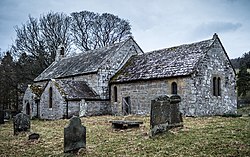
Church of St Michael, Alnham
The Church of St Michael in Alnham, in the English county of Northumberland, is a medieval structure dating from circa 1200. Built on a Roman camp site, it is mentioned in records dating to 1291; it is a Grade I listed building.

2.5 km
Eslington Park
Eslington Park is a privately owned 18th-century mansion house west of Whittingham, Northumberland, near the River Aln. It is the family seat of Lord Ravensworth. It is a Grade II* listed building.
Eslington, first mentioned in the reign of Edward III in 1335, was held in early times by a family who took that name. It later passed into the hands of the Hazelriggs, the Herons, and then the Collingwood's, who lost all when George, the head of the family, was executed for treason in 1716. The Liddells purchased the Eslington estates from the Crown, and the head of the family, Lord Ravensworth, became the chief landowner.
There was a tower house at Eslington in 1415 in the ownership of Thomas Hesilrige. A survey of 1541 reported that the house, in the ownership of Hesilrige but occupied by Robert Collingwood, was in 'good reparation'. George Collingwood was attainted for his treasonable part in the Jacobite rising of 1715. His estate at Eslington was sequestered and sold by the Crown to George Liddell, great uncle of Thomas Henry Liddell, 1st Baron Ravensworth. Liddell built a new two-storey nine-bay mansion house on the site in about 1720, which was extended in 1796.
George's grandson Cuthbert Collingwood, 1st Baron Collingwood (not born until 1748 would go onto become a loyal Hanoverian admiral).