

 English
 Français
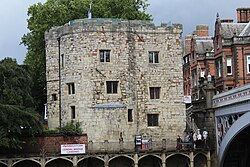
Lendal Tower
Lendal Tower is a medieval tower that formed part of the city defences of York, England. It is located on the east bank of the River Ouse at the point where the river enters the walled city from the north-west. The building was used as a waterworks from 1616 until 1846 after which it was converted into offices. It has since been turned into rental accommodation.
Nearby Places View Menu

46 m
River House, York
River House is a historic building in the city centre of York, in England.
The building was constructed in 1868, as the Yorkshire Club. The Yorkshire Club had been founded in 1839, at 5 St Leonard's Place, and grew by absorbing the Yorkshire Union Hunt Club in 1856. With its larger membership, it decided to move to bigger, purpose-built premises, on a prominent site on the south side of Museum Street, next to Lendal Bridge. The site enabled it to have a private waterfront area on the River Ouse, which is now the Lendal Boatyard. Inside, there was a dining room, bar, billiards room, studies and bedrooms.
The club closed some time after World War II, and was converted to offices. It was Grade II listed in 1971. By 1980, it housed Savills estate agents. From the early 2000s, Pizza Express occupied half the building. It was refurbished in 2017.
The building was designed by Charles Jocelyn Parnell and it is built of brick, with stone dressings and quoins, and granite columns. It has a basement, two main storeys, and attics. The central part of the building is three bays wide, with single-bay wings either side. On the Museum Street front, a portico fills the space between the wings, with a balcony above, and a projecting porch in the centre. The river front is of four bays, with the basement above ground, and a ground floor terrace supported by cast iron columns.

75 m
Lendal Chapel
The Lendal Chapel, also known as 2 Lendal, is a historic building on Lendal, a street in the city centre of York, in England.
The Countess of Huntingdon's Connexion founded a church in York in 1749. A group split away and founded the Grape Lane Chapel in 1781, then in 1796 part of that group split away and founded a chapel on Jubbergate. Many of the worshippers were Congregationalists, and in 1814 the chapel was taken over by the West Riding Itinerant Society, which aimed to consolidate the faith in the region. The group purchased a site on Lendal, and constructed a new church, completed in 1816. The leading figure in the congregation was the architect James Pigott Pritchett, and he designed the new building, which cost more than £3,000. James Parsons was appointed as the pastor, serving for nearly 50 years. The church thrived, and in 1839 the larger Salem Chapel was built on St Saviour's Place, 368 members including Parsons moving to the new church, and 79 remaining at Lendal. This membership stagnated, and there was a rapid turnover of ministers. The building was restored in 1902, but closed in 1929, with the congregation moving to Salem Chapel and then to the New Lendal Congregational Church on Burton Stone Lane. The building was then converted for commercial use, with occupants including shops, a restaurant, and an amusement arcade.
The red brick building has been grade II listed since 1983. It is two storeys high with a basement, and the front is five bays wide, the central three coming further forward and being topped with a pediment. The ground floor is rendered, and is described by Nikolaus Pevsner as "cruelly spoiled". There is a timber cornice, and a pyramidal slate roof. The windows and doors have round heads, and the central main entrance has a hood. At the rear, there is a semicircular apse projecting from the three central bays.

102 m
102 m
Augustinian Friary, York
Augustinian Friary, York was a friary in North Yorkshire, England.
The friary lay in the city centre of York, between the River Ouse and the street now known as Lendal.
The friars were granted a writ of protection by Henry III in July 1272 and Richard III, when he was Duke of Gloucester, stayed at the friary during his visits to York. The friary was surrendered 28 November 1538.