

 English
 Français

Stockton Hall is a late‑18th century country house in the village of Stockton-on-the-Forest near York, United Kingdom. The building is a Grade II listed structure currently in use as a secure psychiatric hospital and owned by the Priory Group
Nearby Places View Menu

339 m
Stockton-on-the-Forest
Stockton-on-the-Forest is a village and civil parish in the unitary authority of the City of York in North Yorkshire, England.
579 m
Danelaw
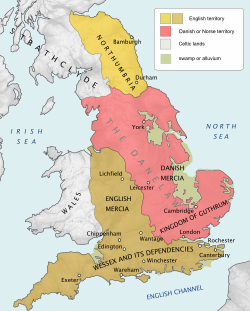
The Danelaw (, Danish: Danelagen; Norwegian: Danelagen; Old English: Dena lagu) was the part of England between the late ninth century and the Norman Conquest under Anglo-Saxon rule in which Danish laws applied. The Danelaw originated in the conquest and occupation of large parts of eastern and northern England by Danish Vikings in the late ninth century. The term applies to the areas in which English kings allowed the Danes to keep their own laws following the early tenth-century Anglo-Saxon conquest of Danish-ruled eastern and northern England in return for the Danish settlers' loyalty to the English crown. "Danelaw" is first recorded in the early 11th century as Dena lage.
The Danelaw originated from the invasion of the Great Heathen Army into England in 865, but the term was not used to describe a geographic area until the 11th century. With the increase in population and productivity in Scandinavia, Viking warriors, having sought treasure and glory in the nearby British Isles, "proceeded to plough and support themselves", in the words of the Anglo-Saxon Chronicle for 876.
The Danelaw can describe the set of legal terms and definitions created in the treaties between Alfred the Great, the king of Wessex, and Guthrum, the Danish warlord, written following Guthrum's defeat at the Battle of Edington in 878, starting with the Treaty of Wedmore.
Between the aftermath of the Treaty of Wedmore and Guthrum's death in 890, the Treaty of Alfred and Guthrum was formalised, defining the boundaries of their kingdoms, with provisions for peaceful relations between the Danes and the Anglo-Saxons, including allowing the self-governance of the Danes in exchange of loyalty to England. The language spoken in England was affected by this clash of cultures, with the emergence of Anglo-Norse dialects.
The Danelaw approximately covered Yorkshire, the central and eastern Midlands, and the East of England.
579 m
Yorkshire
Yorkshire ( YORK-shər, -sheer) is an area of Northern England which was historically a county. Despite no longer being used for administration, Yorkshire retains a strong regional identity. The county was named after the city of York.
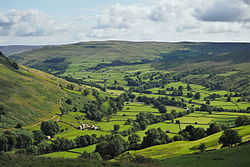
The south-west of Yorkshire includes the cities of Leeds, Sheffield, Bradford, Doncaster and Wakefield. The north and east of the county includes the southern part of the Teesside conurbation; the port city of Hull is located in the south-east. York is positioned near the centre of the county. Yorkshire has a coastline on the North Sea. The North York Moors occupy the north-east of the county, and the centre contains the Vale of Mowbray and the Vale of York. The west contains part of the Pennines, which includes the Yorkshire Dales.
The county was historically bordered by County Durham to the north, the North Sea to the east, Lincolnshire, Nottinghamshire, Derbyshire, and Cheshire to the south, and Lancashire and Westmorland to the west. It was the largest by area in the United Kingdom. From the Middle Ages the county was subdivided into smaller administrative areas; the city of York was a self-governing county corporate from 1396, and the rest of the county was divided into three ridings – North, East, and West. From 1660 onwards each riding had its own lord-lieutenant, and between 1889 and 1974 the ridings were administrative counties. There was a Sheriff of Yorkshire until 1974. Yorkshire gives its name to four modern ceremonial counties: East Riding of Yorkshire, North Yorkshire, South Yorkshire, and West Yorkshire, which together cover most of the historic county.
Yorkshire Day is observed annually on 1 August and is a celebration of the general culture of Yorkshire, including its history and dialect. Its name is used by several institutions, for example the Royal Yorkshire Regiment of the British Army, in sport, and in the media. The emblem of Yorkshire is a white rose, which was originally the heraldic badge of the Plantagenet royal House of York. The county is sometimes referred to as "God's own country". Yorkshire is represented in sport by Yorkshire County Cricket Club and Yorkshire Rugby Football Union.
1.2 km
Brockfield Hall
Brockfield Hall is a country house in Warthill, east of York in North Yorkshire, England.
The hall was built in 1804 for Benjamin Agar, to a design by Peter Atkinson. It is a two-storey building of brick, with a slate roof, and has three bays. It also has a lower two-storey service wing. On the main front, the central, entrance, bay comes further forward. It has a pilastered porch with a balcony above, and the entrance is arched, with double doors. There is a Venetian window to the balcony, while the other windows are all sashes. The central bay of the garden front is bowed, and a single-storey garden room has been added to the left.
Inside the house, the entrance hall is circular, with a cast iron staircase rising through it. There is a decorative cornice and frieze, which may be slightly later than 1804. The drawing room and morning room also have early decoration.
The house was Grade II listed in 1953, and raised to Grade II* listed in 1987. It was purchased by Martin Fitzalan Howard in 1951, and has since been passed down his family. It contains the largest collection of paintings by the Staithes group of artists. The house is open to the public for one month each year.