Glenkiln Sculpture Park

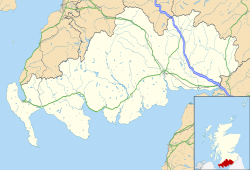
Glenkiln Sculpture Park was a sculpture landscape in the historic county of Kirkcudbrightshire in Dumfries and Galloway, south-west Scotland. After one of the bronze statues was stolen all the statues except the Glenkiln Cross and reclining figures have been removed. It comprised six sculptures placed in a moorland setting around Glenkiln Reservoir. The sculptures were located around 4 kilometres (2.5 mi) north-west of Shawhead, and 12 kilometres (7.5 mi) west of the town of Dumfries. Between 1951 and 1976, local landowner Sir William "Tony" Keswick (grandson of William Keswick) assembled a collection of works by Auguste Rodin, Henry Moore, and Jacob Epstein. Keswick worked with the artists in siting their works in a natural landscape, and commissioned works. On 13 October 2013, the BBC reported that Standing Figure had been stolen. All the sculptures except "Glenkiln Cross" have been removed for security reasons on police advice and are no longer available to view. The sculptures formerly on show are:

Saint John the Baptist (1878) by Auguste Rodin Visitation (1926) by Jacob Epstein Standing Figure (1950) by Henry Moore King and Queen (1952–53) by Henry Moore Upright Motive No. 1: Glenkiln Cross (1955–56) by Henry Moore Two Piece Reclining Figure No.1 (1959) by Henry Moore There is also a memorial to commemorate the diamond wedding of Sir William and Lady Keswick and another to Peter Fleming the travel writer and adventurer, friend of the Keswicks, who used to shoot on the estate.

Nearby Places View Menu
4.2 km

Stepford railway station

Stepford (NX864815) was one of the minor request stop stations on the Cairn Valley Light Railway branch from Dumfries. It served a very rural area in Dumfries and Galloway. The line was closed to passengers during the Second World War.
4.4 km

Newtonairds railway station

Newtonairds (NX877801) was one of the principal stations on the now closed Cairn Valley Light Railway branch from Dumfries. It served a very rural area in Dumfries and Galloway.
Location Image
5.4 km

Crocketford

Crocketford (/ˈkrɒkɪtfɔːd/, also frequently /ˈkrɒkɪtfəd/) also known as Ninemile Bar (Scottish Gaelic: Ath Crogaid), as it is approximately equidistant between Castle Douglas and Dumfries, is a village in the historical county of Kirkcudbrightshire in the Dumfries and Galloway council area near the boundary between Scotland and England. It is located on the A75 road around 9 miles (14 km) west of Dumfries. Crocketford is one of only two settlements that are not bypassed by the A75 along with Springholm, around 2 miles (3 km) to the south-west. The Buchanites were the followers of Elspeth Buchan (1738-1791), who claimed to be the Woman Clad with the Sun from the Book of Revelation. After expulsion from Dumfriesshire they eventually settled at Newhouse in the village. A small burial ground at the property contained the remains of various members of the sect.
Location Image
5.4 km

Dumfries and Galloway

Dumfries and Galloway (Scots: Dumfries an Gallowa; Scottish Gaelic: Dùn Phrìs is Gall-Ghaidhealaibh) is one of the 32 unitary council areas of Scotland, situated in the western part of the Southern Uplands. It is bordered by East Ayrshire, South Ayrshire, and South Lanarkshire to the north; the Scottish Borders to the northeast; and the English county of Cumbria, the Solway Firth, and the Irish Sea to the south. To the west, it faces the North Channel. The administrative centre and largest settlement is the town of Dumfries. The second-largest town, Stranraer, lies approximately 76 miles (122 km) west of Dumfries on the North Channel coast. Dumfries and Galloway corresponds to the historic shire counties of Dumfriesshire, Kirkcudbrightshire, and Wigtownshire, the latter two collectively known as Galloway. These three counties were merged in 1975 to form the Dumfries and Galloway Region, which consisted of four districts. The district system was abolished in 1996, when the area became a single unitary authority under the same name. For lieutenancy purposes, Dumfries and Galloway is divided into three ceremonial areas: Dumfries, Wigtown, and the Stewartry of Kirkcudbright, each corresponding broadly to the former historic counties.