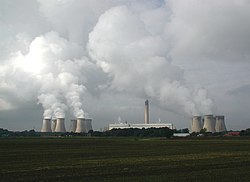
Drax power station is a large biomass power station in Drax, North Yorkshire, England. It has a 2.6 GW capacity for biomass and had a 1.29 GW capacity for coal that was retired in 2021. Its name comes from the nearby village of Drax. It is situated on the River Ouse between Selby and Goole. Its generating capacity of 3,906 megawatts (MW), which includes the shut down coal units, is the highest of any power station in the United Kingdom, providing about 6% of the United Kingdom's electricity supply. Opened in 1974 and extended in the 1980s, the station was initially operated by the Central Electricity Generating Board. Since privatisation in 1990 ownership has changed several times, and it is operated by the Drax Group. Completed in 1986, it was the newest coal-fired power station in England until it closed in 2021. Flue gas desulphurisation equipment was fitted between 1988 and 1995. The high and low pressure turbines were replaced between 2007 and 2012. By 2010, the station was co-firing biomass. In 2012, the company announced plans to convert three generating units to solely biomass, burning 7.5 million tonnes imported from the United States and Canada. This work was completed in 2016 and a fourth unit was converted in 2018. The company planned to convert its remaining two coal units to Combined Cycle Gas Turbine units and 200 MW battery storage. However, those two coal units were shut in 2021 without converting them to biomass. In 2025, the UK government extended its operation to 2031, but at a reduced load factor so it would run less than half as often from 2027 using 100% biomass.

Nearby Places View Menu
Location Image
759 m

Drax Abbey railway station

Drax Abbey railway station was a station on the Hull and Barnsley Railway, and served the village of Drax in North Yorkshire, England. The station opened on 27 July 1885 and closed on 1 January 1932.
768 m

White Rose Project

The White Rose Carbon Capture and Storage project was a proposed oxy-fuel coal-fired power plant near the Drax power station in North Yorkshire, United Kingdom. It was proposed in 2012 by Capture Power Limited (in partnership with National Grid). This project would have been the first coal-fired power plant to demonstrate the use of oxy-fuel technology for low-carbon electricity at a competitive cost. The proposed 426 MW plant was expected to send 2 Mt CO2/year to an offshore saline aquifer, achieving 90% capture. The Development Consent Order application submitted to the Department of Energy and Climate Change, now Department for Business, Energy and Industrial Strategy, was rejected in April 2016. The rejection was on the basis that the project had no route to funding, following the UK government cancelling a carbon capture and storage competition in November 2015.
Location Image
1.4 km

Drax, North Yorkshire

Drax is a village and civil parish in North Yorkshire, England, about 6 miles (10 km) south-east of Selby, which is best known today as the site of Drax power station. It was part of the West Riding of Yorkshire until 1 April 1974. From 1974 to 2023 it was part of the district of Selby, it is now administered by the unitary North Yorkshire Council. The Read School, an independent boarding school in the village, has existed since 1667.
Location Image
1.4 km

Drax Hales railway station

Drax Hales railway station was one of two railway stations that served the village of Drax in North Yorkshire, England. It opened to passengers and goods in 1912 as part of the Selby to Goole line and later closed in 1964 as part of the Beeching cuts. The area is now occupied by the A645 road.