
Location Image

Castlefield corridor

The Castlefield corridor (also known as the Deansgate corridor) is a railway corridor between Castlefield junction and Fairfield Street junction in Greater Manchester, England. The corridor forms the eastern end of both of the Liverpool–Manchester lines. The route is recognised as a significant bottleneck, magnified further by the opening of the Ordsall Chord in 2017 and timetable change in May 2018 which increased the number of services through Manchester city centre from 12 to 15 trains per hour. This uplift in services had a detrimental impact on punctuality and reliability, ultimately playing a major factor in the failure of the Arriva Rail North franchise in 2020. As of August 2021, 12 trains per hour pass through the Castlefield corridor.

Nearby Places View Menu
Location Image
34 m

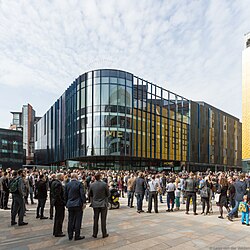
HOME (Manchester)

HOME is an arts centre, cinema and theatre complex in Manchester, England. With five cinemas, two theatres and 500 m2 (5,400 sq ft) of gallery space, it is one of the few arts organisations to commission, produce and present work across film, theatre and visual art.
Location Image
60 m

Statue of Friedrich Engels, Manchester
The statue of Friedrich Engels is a 12 ft (3.7 m) concrete statue of German philosopher Friedrich Engels currently located at Tony Wilson Place in Manchester, England. The Soviet-era statue depicts Engels in a standing pose with his arms crossed, and stands on a pedestal bearing the Cyrillic inscription "Ф. ЭНГЕЛЬС" ("F. ENGELS").
Location Image
89 m

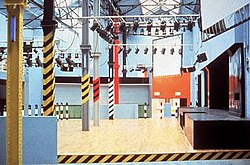
The Haçienda

The Haçienda was a nightclub and music venue in Manchester, England, which became famous during the Madchester years of the 1980s and early 1990s. It was run by the record label Factory Records. The club opened in 1982, eventually fostering the Manchester acid house and rave scene in the late 1980s. The early success of Factory band New Order, particularly with their 1983 dance hit "Blue Monday", helped to subsidise the club even as it lost considerable amounts of money (in part due to clubbers' embrace of the street drug ecstasy, which drove down traditional alcohol sales). The club's subculture was noted by the Chief Constables of Merseyside and Greater Manchester as reducing football hooliganism. Crime and financial troubles plagued its later years, and it finally closed in 1997. It was demolished and replaced by apartments.
91 m

Havelock Mills

Havelock Mills in central Manchester were built between 1820 and 1840. It was probably the largest surviving silk mill in the north-west region in the 1970s and had a unique combination of silk and cotton mills on one site. It was a landmark on the Rochdale Canal, overlooking Tib Lock, one of the Rochdale Nine.