St Trinity House is a historic series of four buildings in the English city of York, North Yorkshire. Grade II listed and forming the southern end of King's Square, parts of the structures date to the early 18th century, with alterations occurring over the next two hundred years. Their addresses today range from 3 to 4A King's Square. The Duke of York pub is at Nos. 3 and 4; and the current use of No. 4A, the oldest building in the range, is not known. The only rendered front of the four, it adjoins 1 The Shambles to form an L-shape at the southwestern corner of the square. In the early 20th century, both buildings were the home of G. Ackroyd Furniture Stores. In 1430, the site was occupied by shops by the name of Le Mercery and by a building known as Hellekeld (the dark well). These were believed to be a precursor to Pump Court. Three of the buildings are 20th-century remodels of 15th-century (or earlier) structures, one of which was altered in the 17th century, while two were rebuilt in the early part of the 18th century. The other one is a 20th-century structure. Each 15th-century structure retains its timber framing. The first floor of No. 4A is jettied towards Newgate and retains its dragon beam on that corner. (The first building at what appears to be the beginning of Newgate is actually 5 and 6 King's Court.) The buildings were in the shadow of Holy Trinity Church (for which the building is named), which stood immediately to the north in what was then King's Court, between the 15th century and the church's demolition in 1937.

Nearby Places View Menu
Location Image
11 m

York

York is a cathedral city in North Yorkshire, England, with Roman origins, sited at the confluence of the rivers Ouse and Foss. It has many historic buildings and other structures, such as a minster, castle and city walls, all of which are Grade I listed. It is the traditional county town of Yorkshire, and the administrative centre of the City of York district. It is located 27 miles (43 km) north-east of Leeds, 90 miles (140 km) south of Newcastle upon Tyne and 207 miles (333 km) north of London. York's built-up area had a recorded population of 141,685 at the 2021 census. The city was founded under the name of Eboracum in AD 71. It then became the capital of Britannia Inferior, a province of the Roman Empire, and was later the capital of the kingdoms of Deira, Northumbria and Scandinavian York. In the Middle Ages it became the northern England ecclesiastical province's centre, and grew as a wool-trading centre. In the 19th century it became a major railway network hub and confectionery-manufacturing centre. In the Second World War York was bombed in the Baedeker Blitz. Although York was less targeted during the war than other, more industrialised northern cities, several historic buildings were gutted and restoration took place up until the 1960s. Historic local governance of the city was as a county corporate, not included in the county's riding system. The city has since been locally governed as a municipal borough, county borough, and since 1996, a non-metropolitan district (the City of York), which also includes surrounding villages and rural areas, and the town of Haxby. The current district's local council, City of York Council, is responsible for providing all local services and facilities throughout this area.
Location Image
18 m

1 The Shambles

1 The Shambles (also known as Barghest) is a historic building in York, England. A Grade II listed building, standing at the corner of The Shambles and Newgate, part of the building dates to the 14th century, but it was renovated in the 17th and 18th centuries. Its Newgate façade faces King's Square, and this has the functioning doorway to the building. It is this side of the building, which is two storeys, that dates to the 14th century. It adjoins 4A King's Square to form an L-shape. The western side is three storeys, dating to the second half of the 18th century. Nos. 1 to 5 were modernised in 1970–71, the result of which created a series of individual businesses, with a single suite above for office space.
Location Image
19 m

7–8 The Shambles

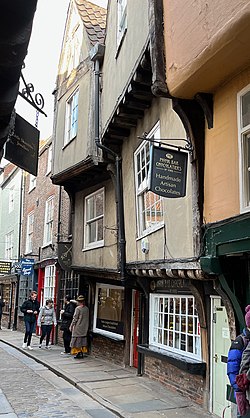
7–8 The Shambles is a historic pair of buildings in York, England. Grade II* listed buildings dating to the early and late 15th century, they are located on The Shambles. No. 8 is the older house, and was built in the early 1400s. It originally had one room on each of its three storeys, with a courtyard behind, but in the 16th century, the yard was infilled with a two-storey extension. In about 1700, the extension was reduced in length, and a further extension was added, which included a kitchen. In the 19th century, the level of the second floor was raised. No. 7 was built in the late 1400s, filling the space between No. 8 and a now-demolished building. Like No. 8, it is of three storeys, each of which is jettied. Each floor is divided into three rooms, one behind another, although the position of the partitions has been altered over time. In the 18th century, the rearmost bay of the building was shortened. Inside, there is a 17th-century chimney breast, built of brick, and much of the original timber framing survives. The fireplace on the first floor is original. Both buildings have been converted into shops, with an office on the top floor. Since 2002, the shops have been occupied by Monk Bar Chocolatiers.
Location Image
19 m

3–5 The Shambles

3–5 The Shambles is a historic trio of buildings in York, England. Grade II listed, parts of the structures date to the early 19th century. Its orange-grey bricks are in Flemish bond, while the shopfront and guttering is made of timber. One of the buildings formerly served as the Shoulder of Mutton public house. Nos. 1 to 5 were modernised in 1970–71, the result of which created a series of individual businesses, with a single suite above for office space. As of 2018, the buildings were occupied by Take One Gifts and The Shambles Sweet Shop.