

 English
 Français
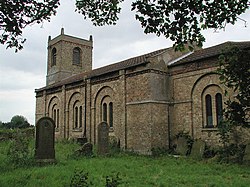
Rimswell
Rimswell est une paroisse civile et un village du Yorkshire de l'Est, en Angleterre.
1. Notes et références
(en) Cet article est partiellement ou en totalité issu de l’article de Wikipédia en anglais intitulé « Rimswell » (voir la liste des auteurs).
1. Liens externes
Ressource relative à la géographie : Open Domesday
Portail du Yorkshire
Nearby Places View Menu
3.2 km
Winestead Hall
Winestead Hall was a large country house at Winestead in the East Riding of Yorkshire, England.

3.7 km
Hollym Gate railway station
Hollym Gate railway station is a disused railway station on the North Eastern Railway's Hull and Holderness Railway to the west of Hollym, East Riding of Yorkshire, England. It was opened in 1855. The station was closed to passengers on 1 September 1870.

3.7 km
Withernsea Lifeboat Station
Withernsea Lifeboat Station is located in the town of Withernsea, East Riding of Yorkshire, England. It is one of four RNLI stations in the East Riding of Yorkshire, with another five in North Yorkshire.
A lifeboat was first stationed at Withernsea in 1862, by the Royal National Lifeboat Institution (RNLI). The station was closed in 1913, when the lifeboat was relocated to Easington. It was reopened as an Inshore lifeboat station in 1974.
The station currently operates a D-class (IB1) Inshore lifeboat Mary Beal (D-837), on station since 2019.

4.2 km
Halsham
Halsham is a village and civil parish in the East Riding of Yorkshire, England, in an area known as Holderness. It is situated approximately 4 miles (6.4 km) west of Withernsea town centre and it lies south of the B1362 road.
According to the 2011 UK census, Halsham parish had a population of 255, a decrease on the 2001 UK census figure of 260.
The name Halsham derives from the Old English halshām meaning 'village on a neck of land'.
The parish church of All Saints was designated a Grade I listed building in 1966 and is now recorded in the National Heritage List for England, maintained by Historic England. To the east of the church is a Mausoleum of the Constable family which is designated as a Grade II* listed building. Halsham House, a former school, dates to the late 16th century.
HMS Halsham, a Ham class of inshore minesweeper, was named after the village.
In 1823 inhabitants in the village numbered 315. Occupations included sixteen farmers, three wheelwrights, a bricklayer, a grocer, a blacksmith, and the landlord of the Sun public house. A carrier operated between the village and Hull on Tuesdays. The village was described as consisting of "chiefly a number of respectable farm houses, scattered at irregular distances from each other." The mausoleum to the Constable family is described as of stone, with polished white marble facing, with, at its centre, a monument to Sir William Constable (Historic England credits it to Sir Edward; Pevsner to Sir William), built at a cost of £10,000. Sir John Constable of Kirby Knowle in 1584 left 80/- (shillings) per year from his estate to be paid out in perpetuity: 20/- for the education of eight poor children with a further 24/- for their satchels and books; 32/- for eight poor men; and 4/- for two poor women. He provided for a hospital for the use of the poor men and women of the parish.

4.3 km
Winestead
Winestead is a village in the civil parish of Patrington, in the East Riding of Yorkshire, England, in an area known as Holderness. It is situated approximately seven miles (eleven kilometres) south-east of Hedon and 1+1⁄2 miles (2.5 kilometres) north-west of Patrington. It is situated to the north of the A1033 road. In 1931 the parish had a population of 153. On 1 April 1935 the parish was abolished and merged with Patrington.
The name Winestead possibly derives from the Old English wīfstede meaning 'women's place'. Another theory derives it from Wifastede or Wifestede, meaning 'Wifa/Wife's place'.
It is also the ancient seat of the Hildyard/Hilliard/Hildegardis family, whose ancestry is believed to be of Saxon origin. The Hildyard family of Winestead became extinct on the death of Sir Robert D'Arcy Hildyard, Bart., who died without heirs in 1814. Hildyard bequeathed his estates to his niece, Ann Catherine Whyte, who married in the following year Thomas Blackborne Thoroton, Esq., of Flintham Hall, Flintham, Nottingham. Col. Thoroton of the Coldstream Guards subsequently assumed the name and coat-of-arms of Hildyard. His heirs, who still have the surname Hildyard, reside at Flintham Hall today. The Hildyard family lived at Winestead for 10 generations, and even after the death of the last Baronet, the heirs continued to own Winestead Hall.
In 1823 inhabitants in the village numbered 129. Occupations included six farmers.
The church of St Germain was designated a Grade I listed building in 1966 and is now recorded in the National Heritage List for England, maintained by Historic England.
The White Hall was designated a Grade II* listed building in 1966 and is now recorded in the National Heritage List for England, maintained by Historic England.
Winestead was served from 1854 to 1964 by Winestead railway station on the Hull and Holderness Railway.