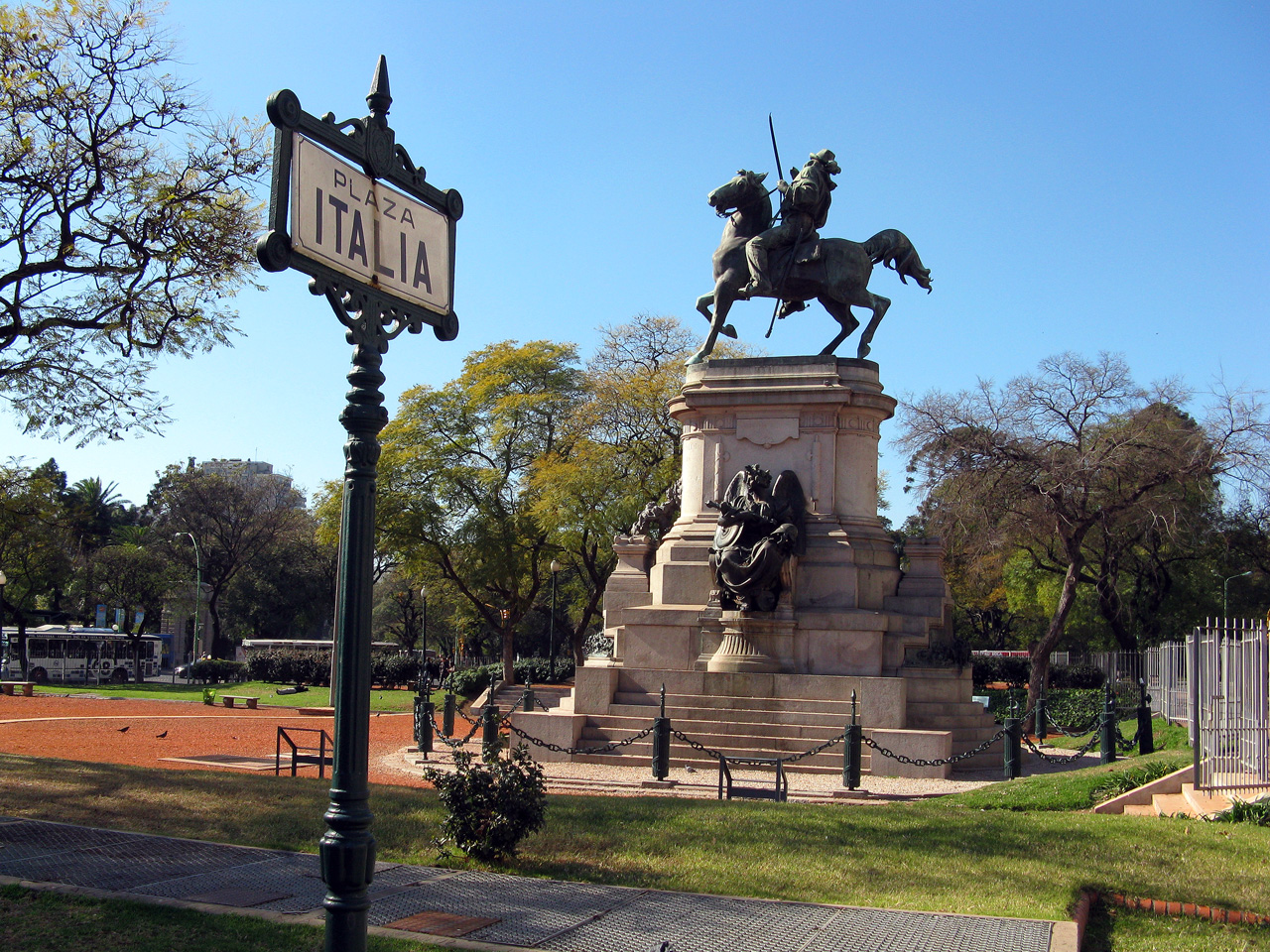
Plaza Italia is a small park in the city of Buenos Aires in the barrio of Palermo on the confluence of Santa Fe Avenue and Avenida Sarmiento. Next to the plaza are the main entrances to the Zoo and the Botanical Gardens, and the la Rural Expo Center. The area is very busy with traffic, as it is a public transportation hub for the city. In the center of the park there is an equestrian statue to Giuseppe Garibaldi, which opened on 19 June 1904 in a ceremony attended by Presidents Julio Argentino Roca and Bartolomé Mitre. Under the park there is a metro station of the same name in the "D" line of the system. On the corner of the Plaza and the Exposition Center there is a Roman column, original from the Roman Forum, donated by the city of Rome. More than 2,000 years old, it is one of the oldest monument in the city.

Nearby Places View Menu
Location Image
7 m

Monument to Giuseppe Garibaldi (Buenos Aires)

The Monumento a Giuseppe Garibaldi is an equestrian sculpture featuring Giuseppe Garibaldi, located on Plaza Italia, a landmark in the Palermo neighbourhood of Buenos Aires, Argentina. Giuseppe Garibaldi (1807–1882) was an Italian military and political figure. In his twenties, he joined the Carbonari Italian patriot revolutionaries, and had to flee Italy after a failed insurrection. He then led the Italian Legion in the Uruguayan Civil War, and afterwards returned to Italy as a commander in the conflicts of the Risorgimento. He has been dubbed the "Hero of the Two Worlds" in tribute to his military expeditions in both South America and Europe. Donated to the city by Italian residents, it was built by Italian sculptor Eugenio Maccagnani as a replica of the one located in Brescia, Italy, and was inaugurated on June 19, 1904.
Location Image
18 m

Plaza Italia (Buenos Aires Underground)

Plaza Italia station is part of the line D of the Buenos Aires Underground. It is located at the intersection of Avenida Santa Fe and the roundabout surrounding Plaza Italia in Palermo. The station was opened on 23 February 1940 as part of the extension of Line D from Tribunales to Palermo. A short distance from the station are the La Rural fairgrounds, owned by the Sociedad Rural Argentina, the former Buenos Aires Zoo (now "EcoParque"), and the Botanical Garden. In 1997 the station was declared a national historic monument.
Location Image
96 m

Buenos Aires Eco-Park

The Buenos Aires Eco Park (Spanish: Ecoparque de Buenos Aires) is an 18-hectare (44-acre) park in the Palermo district of Buenos Aires, Argentina. The former zoo, opened in 1888, contained 89 species of mammals, 49 species of reptiles and 175 species of birds, with a total of over 2,500 animals. The institution's goals are to conserve species, produce research and to educate the public. In June 2016 the city formed a bias about the zoo's cruelty. They had to close the 140-year-old zoo and relocate most of the animals to nature reserves, including Temaikèn. The zoo property will be converted into an ecopark. The zoo (which had been declared National Historic Monument of Argentina in 1997) closed in 2016, reopening as an ecopark in 2018. Its more than 40 historic buildings (that had been declared historical heritage) were refurbished, including the arc at the main entrance, the parrots pavilion, the Byzantine ruins, the Confitería del Aguila, and the herons bridge, among others. The former zoo was declared .
Location Image
249 m

Buenos Aires Botanical Garden

The Buenos Aires Botanical Garden (official name in Spanish: Jardín Botánico Carlos Thays de la Ciudad Autónoma de Buenos Aires) is a botanical garden located in the Palermo neighborhood of Buenos Aires in Argentina. The garden is triangular in shape, and is bounded by Santa Fe Avenue, Las Heras Avenue and República Árabe Siria Street. The garden, which was declared a national monument in 1996, has a total area of 6.9772 ha (0.026939 sq mi; 17.241 acres), and holds approximately 5,500 species of plants, trees and shrubs, as well as a number of sculptures, monuments and five greenhouses.