

 English
 Français
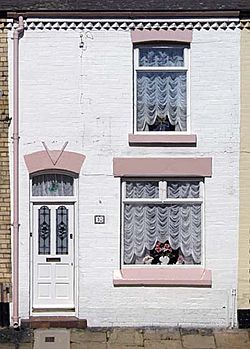
Le 10 Admiral Grove à Liverpool, dans le quartier Toxteth, est la maison d'enfance de Ringo Starr, célèbre batteur des Beatles.
Nearby Places View Menu
4 m
10 Admiral Grove
10 Admiral Grove, a property in Toxteth, Liverpool, England, is the house in which Ringo Starr lived for twenty years before he rose to fame with the Beatles.
Starr's infant school, St. Silas Primary School, on Pengwern Street, was yards away from his front door. He was a sickly child and, due to his many absences from school, was taught to read and write at home. A severe bout of peritonitis led him to spend much of his seventh year at the Royal Children’s Hospital. When Starr was 13, his mother Elsie married a Londoner, Harry Graves. The Starkeys' local pub, The Empress, where Elsie was a barmaid, adjoins Admiral Grove. The pub was featured on the front cover of Starr's first solo album Sentimental Journey (1970). During "Beatlemania", the documentary The Mersey Sound, filmed by BBC producer Don Haworth, showed Starr being mobbed by fans on Admiral Grove as he made his way to George Harrison's open-topped sports car.

112 m
Welsh Streets, Liverpool
The Welsh Streets are a group of late 19th century Victorian terraced streets in Toxteth, Liverpool, England. The houses were designed by Welsh architect Richard Owens and built by Welsh workers to house workers mainly involved in the industries on the docks; the streets were named after Welsh villages and landmarks.
The Beatles drummer Ringo Starr was born in Madryn Street in 1940. Although several of the original houses were lost in World War II bombing, most of the terraced properties in the original street configuration remain standing some 150 years after being built.
Following a period of decline in the late 20th century, plans were announced in the early 2000s as part of the Housing Market Renewal Initiative programme to demolish the estate and build new, but fewer, houses in their place. Despite the area being cleared of residents and houses prepared for demolition at a cost to Liverpool City Council of nearly £22 million, funding for the planned redevelopment was withdrawn in 2011 following the change in government and spending cuts, and the demolition did not take place.
Subsequent revised demolition and renewal proposals by the council and housing group Plus Dane were rejected by the government due to concerns about the negative impact they would have on the city's cultural heritage. Instead, a housing renewal company took ownership of some of the properties, initially in a pilot scheme, to extensively renovate them and make them available for rent. The first new tenants moved into Voelas Street around September 2017. Placefirst, the company renovating the properties, won an award in November 2018 for the standard of the refurbishments.

217 m
Royal Park Hotel, Toxteth
The Royal Park Hotel was a three-storey, handsome public house and hotel situated on the corner of Admiral Street and North Hill Street, Toxteth, Liverpool, England. It was built in the 1860s1 as a three-storey building possibly by the brewer Walkers of Warrington. A long bar ran the length of the pub curving at the end; two other rooms had no bar and were served by waiter service, which disappeared towards the end of the pub's life. The name of the pub probably refers to the fact that Toxteth was a Royal Park – although in the interwar years the name changed to the Admiral Hotel.2 In the 1871 England census, it is recorded as being at 2 Admiral Street, Toxteth Park and in Ordnance Survey maps of the period it is marked as a PH on the corner of Admiral Street and North Hill Street – with a Freemasons' hall adjacent to it at 80 North Hill Street. However, in some Censuses the hotel is recorded as being at 84 North Hill Street.
A history of the Ancient Briton Lodge records that "some time prior to 1877 a hotel had been built on the corner of Admiral Street and North Hill Street called the Masonic Arms" – although no other record of that name has yet been found.

361 m
High Park Reservoir
High Park Reservoir (also known as Toxteth Reservoir) is a disused reservoir in the Toxteth district of Liverpool, England. Water for the reservoir was enclosed in a brick-built, sandstone-clad building. The building still stands and is opened to visitors for special occasions and events.

379 m
Our Lady of Mount Carmel Roman Catholic Church, Liverpool
Our Lady of Mount Carmel is a Roman Catholic Church on High Park Street in Dingle, Liverpool. The church was built when the parish population had outgrown the nearby Church of St Patrick on Park Place. Initially, from 1866, a chapel dedicated to Our Lady of Mount Carmel was used in the school. The church proper opened on 21 July 1878.
In December 2009 the church and the adjoining presbytery gained Grade II listed status.
In 2001, the parish of Our Lady of Mount Carmel incorporated the nearby parish of St Finbar. The latter church had closed and was later demolished in 2003.