
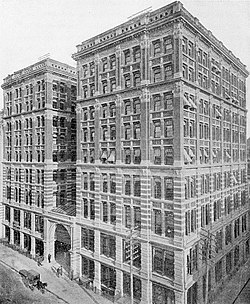
The Blair Building, also known as the Blair and Company Building, was an early skyscraper in Lower Manhattan, New York City.

1. History

It was constructed in 1902–1903. It was located at 24 Broad Street in the Financial District of Manhattan, New York City, and had a white marble facade. It was built by Andrew J. Robinson Company. The Architectural Record ran an article about it in 1903 titled "A Beaux-Arts Skyscraper". It was demolished in 1955. It was designed by Carrere and Hastings and Edwin Thayer Barlow of the firm was the supervising architect for construction. Henry W. Post was the building's structural engineer. He also worked on the Gillender Building. In 1928 the building was purchased to be part of the expanding New York Stock Exchange Building complex. Irving Underhill photographed the building in 1932. It was next to the adjoining Commercial Cable Building built in 1897 at 20 Broad Street.

1. See also

John Insley Blair DeWitt Clinton Blair C. Ledyard Blair

1. References


1. External links

Archival photos of the Blair Building Art Institute of Chicago

Nearby Places View Menu
Location Image
14 m

Mills Building (New York City)

The Mills Building was a 10-story structure that stood at 15 Broad Street and Exchange Place in Manhattan, with an L-shaped extension to 35 Wall Street. It wrapped around the J. P. Morgan & Company Building at 23 Wall Street, on the corner of Broad and Wall Streets. George B. Post was the architect of the edifice. D.O. Mills, a San Francisco, California banker, owned the property. Mills built a palatial home in New York City, while maintaining a villa in Millbrae, California.
Location Image
28 m

Fearless Girl

Fearless Girl is a bronze sculpture by Kristen Visbal of a 4-foot-high (1.2 m) girl standing in a self-confident pose. It is located in New York City on Broad Street across from the New York Stock Exchange Building in the Financial District of Manhattan. Fearless Girl was commissioned by State Street Investment Management, formerly State Street Global Advisors (SSGA), a large asset management company, to promote gender diversity initiatives and an index fund focused on gender-diverse companies with a relatively high percentage of women in senior leadership. As of 2025, State Street quietly backed away from its commitment to diversity, and the statue's future remains uncertain. The statue was first installed at the northern tip of Bowling Green on Broadway, facing the sculpture Charging Bull on March 7, 2017, in anticipation of International Women's Day on the following day. Following complaints from Charging Bull sculptor Arturo Di Modica, Fearless Girl was removed in November 2018 and relocated to its Broad Street location the following month. A plaque with footprints was placed on the original site of Fearless Girl.
31 m

Stock Exchange Luncheon Club

The Stock Exchange Luncheon Club was a members-only dining club, on the seventh floor of the New York Stock Exchange Building at 11 Wall Street in Manhattan. The club was founded on August 3, 1898, and moved from 70 Broadway to 11 Wall Street when the New York Stock Exchange (NYSE) opened its new building in 1903. It closed on April 28, 2006, after more than a century of service. The club had an inaugural membership of 200, with a "long waiting list", when it first opened as the Luncheon Club at 70 Broadway and 15 New Street, Manhattan. Joseph L. Searles III, who became the first African American member of the NYSE when he joined in 1970, said that his "biggest fear...was where would I sit in the luncheon club?". The situation was resolved when Searles was given his own table by the club, and he dined alone for a while. A ladies' restroom was installed in the club as late as 1987, some twenty years after women were first admitted to the NYSE. In 1999, the club had more than 1,400 members, and was lavishly decorated with various animal heads, most shot by members on safari. In August 2001, the Stock Exchange Luncheon Club served as the venue for the presentation of custom-made motorized wheelchairs to 17 quadraplegic in-patients of a local hospital for paralyzed people. A fund-raising event was held by the New York City Police Foundation at the club in November 2003. Following security measures put in place at the NYSE, after the September 11 attacks, the club became less accessible, and this, coupled with the ousting of regular patron Richard Grasso from the head of the NYSE, and a decline in similar local dining clubs, was cited as a factor in the club's demise when it closed in 2006. The space continued to be used for important events for example, the NYSE shareholder vote to merge with Euronext on December 19, 2006.
Location Image
31 m

Commercial Cable Company Building

The Commercial Cable Company Building was an early skyscraper at 20–24 Broad Street Extension in Manhattan, New York City. Built for the Commercial Cable Company, it started construction in 1896 and was completed in 1897. It was designed by Harding & Gooch. Its height was 92.7 m (304 ft) and it was 22 stories tall. The building, like many of its contemporaries, was built in a historicist style, richly decorated. Two domes were designed on top. The building adjoined the New York Stock Exchange. The Exchange leased the western portions of the first three floors in 1926, which were remodeled to include an trading floor. It stood for half a century and was demolished in 1954. A 27-story modern office building was built in its place.