

 English
 Français

Dumbreck
Dumbreck (; Scottish Gaelic: An Dùn Breac, lit. 'the Speckled Fort' or Scottish Gaelic: Druim Breac, lit. 'Speckled Ridge') is an area in the city of Glasgow, Scotland. It is situated south of the River Clyde. Dumbreck is a conservation area. The district is served by Dumbreck railway station. The only church in Dumbreck is St Leo the Great RC church.
Nearby Places View Menu

360 m
Bellahouston
Bellahouston ( bel-a-HOOS-tən; Scottish Gaelic: Baile Ùisdean) is a district in the southwest of Glasgow. It is bordered by Dumbreck, Ibrox, Pollokshields, Craigton.

437 m
Dumbreck railway station
Dumbreck railway station is a railway station in Dumbreck, a district of Glasgow, Scotland. The station is managed by ScotRail and lies on the Paisley Canal Line, 1+3⁄4 miles (3 kilometres) west of Glasgow Central, close to the M77 motorway. It is accessed from the Nithsdale Road at the bridge over the railway. Dumbreck railway station is also the closest station for the Bellahouston Park and Ibrox Stadium.
477 m
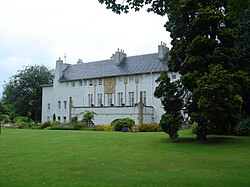
House for an Art Lover
The House for an Art Lover is an arts and cultural centre in Glasgow, Scotland. The building was constructed between 1989 and 1996 based on a 1901 Art Nouveau house design by Charles Rennie Mackintosh and his wife, Margaret MacDonald. The house is situated in Glasgow's Bellahouston Park and sits east of the site of the Festival Tower of the Empire Exhibition, Scotland of 1938.
The idea to actually build the house from the Mackintoshs' designs came from Graham Roxburgh, a civil engineer in Glasgow who had done refurbishment work on the Mackintosh interiors in Craigie Hall. The house is a prominent example of the Modern Style. It serves as a venue for art exhibitions and other events, as well as being itself a visitor attraction.

541 m
Empire Exhibition, Scotland
The Empire Exhibition was an international Exhibition held at Bellahouston Park in Glasgow, Scotland, from May to December 1938.
The Exhibition offered a chance to showcase and boost the economy of Scotland and celebrate Empire trade and developments, recovering from the depression of the 1930s. It also marked fifty years since Glasgow's first great exhibition, the International Exhibition (1888) held at Kelvingrove Park. It was the second British Empire Exhibition, the first held at Wembley Park, London, in 1924 and 1925.
Its function was similar to the first National Exhibition in Paris in 1798 and to the first International Exhibition, the Great Exhibition in London in 1851, attended by 6 million visitors.
It was declared open by King George VI and Queen Elizabeth on 3 May 1938 at the Opening Ceremony in Ibrox Stadium, attended by 146,000 people.
In addition to the Royal Patrons and the Honorary Presidents representing governments and institutions here and in the Dominions, the Exhibition President was the Earl of Elgin, President of the Scottish Development Council, and initiators of the exhibition.