

 English
 Français
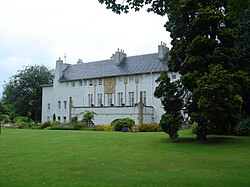
House for an Art Lover
The House for an Art Lover is an arts and cultural centre in Glasgow, Scotland. The building was constructed between 1989 and 1996 based on a 1901 Art Nouveau house design by Charles Rennie Mackintosh and his wife, Margaret MacDonald. The house is situated in Glasgow's Bellahouston Park and sits east of the site of the Festival Tower of the Empire Exhibition, Scotland of 1938. The idea to actually build the house from the Mackintoshs' designs came from Graham Roxburgh, a civil engineer in Glasgow who had done refurbishment work on the Mackintosh interiors in Craigie Hall. The house is a prominent example of the Modern Style. It serves as a venue for art exhibitions and other events, as well as being itself a visitor attraction.
Nearby Places View Menu

143 m
Empire Exhibition, Scotland
The Empire Exhibition was an international Exhibition held at Bellahouston Park in Glasgow, Scotland, from May to December 1938.
The Exhibition offered a chance to showcase and boost the economy of Scotland and celebrate Empire trade and developments, recovering from the depression of the 1930s. It also marked fifty years since Glasgow's first great exhibition, the International Exhibition (1888) held at Kelvingrove Park. It was the second British Empire Exhibition, the first held at Wembley Park, London, in 1924 and 1925.
Its function was similar to the first National Exhibition in Paris in 1798 and to the first International Exhibition, the Great Exhibition in London in 1851, attended by 6 million visitors.
It was declared open by King George VI and Queen Elizabeth on 3 May 1938 at the Opening Ceremony in Ibrox Stadium, attended by 146,000 people.
In addition to the Royal Patrons and the Honorary Presidents representing governments and institutions here and in the Dominions, the Exhibition President was the Earl of Elgin, President of the Scottish Development Council, and initiators of the exhibition.
299 m
Tait Tower
Tait Tower (also known as Tait's Tower and officially as the Tower of Empire) was a tower in the art deco style constructed at the summit of Ibrox Hill in Bellahouston Park in Glasgow in Scotland as part of the Empire Exhibition, Scotland 1938.
It was designed by Thomas S. Tait, stood 300 feet (91 metres) high and had three separate observation decks which provided a view of the surrounding gardens and city. Due to both the height of the tower and the hill it was built on, it could be seen 100 miles (160 km) away. The tower was the centrepiece of the Empire Exhibition and its image featured on many of the souvenirs that could be bought at the exhibition site.
The Empire Exhibition took place at a time when Glasgow was the centre of British shipbuilding and engineering, and the materials – steel beams riveted together and clad in corrugated steel – were produced by Glasgow manufacturing plants. Tait's design and readily available materials made it possible for the tower to be constructed in only nine weeks.
The tower was dismantled in July 1939 after the exhibition closed. The foundations remain at Bellahouston Park.
Thomas' son Gordon Tait also worked on the project.
In December 2007, the Tait Tower was included in a 3D graphic reconstruction of the Empire Exhibition by the Digital Design Studio at Glasgow School of Art, sourced from contemporary photographs, film footage, sketches and drawings from the archive of the Mitchell Library.
308 m
Ibrox railway station
Ibrox railway station was a railway station in Ibrox, a district of Glasgow, Scotland. The station was originally part of the Glasgow and Paisley Joint Railway.
344 m
Bellahouston Park Halt railway station
Bellahouston Park Halt railway station served the district of Bellahouston, Glasgow, Scotland, from 1938 to 1939 on the Paisley Canal line.