

 English
 Français

Winterburn
Winterburn is a village in the county of North Yorkshire, England. It is about 5 miles (8 km) south west of Grassington. Winterburn Reservoir is located about a mile from the village, which is situated on Winterburn Beck, the reservoir's outlet. Friars Head Hall lies in the village, on a site formerly occupied by a grange of Furness Abbey. Until 1974 it was part of the West Riding of Yorkshire. From 1974 to 2023 it was part of the district of Craven, it is now administered by the unitary North Yorkshire Council.
Nearby Places View Menu

98 m
Winterburn Chapel
Winterburn Chapel is a historic building in Winterburn, a village in North Yorkshire, in England.
There was a mediaeval chapel in Winterburn, but it did not survive the English Reformation. In the mid 17th century, an independent congregation was established, meeting in the houses of John Hey and Richard Mitchell. In 1677, the first Nonconformist ordination in Yorkshire took place there. A few years later, a Mrs Lambert founded a dedicated Presbyterian chapel, intended to serve local miners. Oliver Heywood preached many of his earliest sermons in the chapel. The chapel was restored in 1862, when a vestry was added at the west end, at which time it was a Congregationalist chapel. There were further alterations in the 20th century. It was grade II listed in 1954, at which time it was serving as an Anglican chapel of ease to St Andrew's Church, Gargrave. It has since been converted into a house.
The building is constructed of rendered stone, with eaves modillions and a stone slate roof. It has one storey and five bays. The central entrance has a chamfered surround and a Tudor arched lintel, and the outer bays contain double-chamfered mullioned windows. At the west end is the gabled former vestry. Before conversion, it contained seven rows of box pews.

1.1 km
Friars Head Hall
Friars Head Hall is a historic building in Winterburn, a village in North Yorkshire, in England.
In the mediaeval period, a monastic grange of Furness Abbey lay on the site. Friars Head Hall was first recorded around 1500, at which time it was owned by the Proctor family, who claimed to have held it since about 1300. The current building dates from the 17th century. It is in the Jacobean style, and is described by Nikolaus Pevsner as "unusually good". It was altered in the 19th century, and again in the 20th century. In 1954, it was grade II* listed.
It is a large house in gritstone with a stone slate roof, consisting of a hall range and two rear cross-wings. There are two storeys, and a garden front of four projecting bays. Each bay has a gable with kneelers and ball finials, below which are mullioned and transomed windows with hood moulds, those in the top floor with three truncated-ogee lights. In the second bay is a porch with a moulded surround and imposts, a basket arch with voussoirs, and a Tudor arched doorway. Above is a hood mould, and a sundial with a gnomon and a moulded surround. Inside, there is a massive inglenook fireplace, a small fireplace in the former parlour, and upstairs are three late 17th century door surrounds.

1.7 km
Brockabank
Brockabank is a historic building in Winterburn, a village in North Yorkshire, in England.
The manor of Brockabank was first recorded in 1188. The oldest parts of the current farmhouse date from the late 16th century, while much of the structure is early or mid 17th century. It was altered in the 18th century, heavily restored in the 19th century, and further altered in the 20th century. It was grade II* listed in 1954.
The building is constructed of stone, with shaped eaves modillions, and a stone slate roof with coped gables, and kneelers with ball finials. It has two storeys and five bays. On the front is a re-used doorway with a round-arched head, a chamfered surround, and moulded impost blocks. Most of the windows are chamfered and mullioned, some with hood moulds, and here are later casements. Inside, there is an inglenook fireplace.
2.2 km
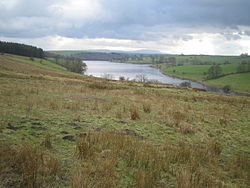
Winterburn Reservoir
Winterburn Reservoir is located near the village of Winterburn in Malhamdale, North Yorkshire, England. It was constructed between 1885 and 1893 by Leeds civil engineers Henry Rofe and Edward Filliter to help maintain levels on the Leeds and Liverpool Canal. The cost of construction was estimated at £45,000. Its capacity is 281,504,000 imperial gallons (1.27974×10⁹ L; 338,072,000 US gal) and covers an area of 39.17 acres (15.85 ha)
In order to maintain the water levels of Winterburn and Eshton Beck, there is a compensation scheme. Around 1.1×10⁶ imperial gallons; 1.3×10⁶ US gallons (5×10⁶ L) of water are discharged per day. The amount of compensation water is measured in the gauge house below the reservoir and further downstream at Holme Bridge lock, Gargrave.
In order to maintain the aquatic life in the reservoir, this is monitored daily, and in times of drought the water discharged into Winterburn Beck is reduced.