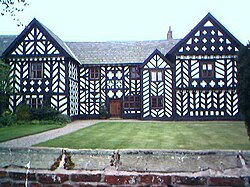
Crewe Hall est un manoir jacobéen situé près de Crewe Green, à l'est de Crewe, dans le Cheshire, en Angleterre. Décrit par Nikolaus Pevsner comme l'une des deux plus belles maisons jacobines du Cheshire, il est classé au grade I. Construit en 1615-1636 pour Sir Randolph Crewe, c'est l'une des plus grandes maisons du comté au XVIIe siècle et aurait "amené Londres dans le Cheshire". La maison est agrandie à la fin du XVIIIe siècle et modifiée par Edward Blore au début de l'ère victorienne. Elle est largement restaurée par Edward Middleton Barry après un incendie en 1866 et est considérée comme l'une de ses meilleures œuvres. Parmi les autres artistes et artisans employés lors de la restauration figurent John Birnie Philip, JG Crace, Henry Weekes (en) et la société Clayton and Bell. L'intérieur est richement décoré et contient de nombreux exemples de sculptures sur bois, de cheminées et de plâtres, dont certains datent de la période jacobéenne. Le parc est aménagé au XVIIIe siècle par Capability Brown, William Emes, John Webb et Humphry Repton, et des jardins à la française sont conçus par William Andrews Nesfield au XIXe siècle. Sur le domaine se trouvent des cottages conçus par le fils de Nesfield, William Eden Nesfield, que Pevsner considère comme ayant introduit des fonctionnalités telles que la pose de carreaux et le pargetting dans le Cheshire. Le quadrilatère des écuries est contemporain de la maison et est classé au grade II*. La maison est restée le siège de diverses branches de la famille Crewe jusqu'en 1936, date à laquelle le terrain est vendu au Duché de Lancastre. Il sert de bureaux après la Seconde Guerre mondiale, comme siège à la Fondation Wellcome pendant près de trente ans. Depuis 2019, il est utilisé comme hôtel, restaurant et club de santé.

Nearby Places View Menu
Location Image
0 m

Crewe Hall

Crewe Hall is a Jacobean mansion located near Crewe Green, east of Crewe, in Cheshire, England. Described by Nikolaus Pevsner as one of the two finest Jacobean houses in Cheshire, it is listed at grade I. Built in 1615–36 for Sir Randolph Crewe, it was one of the county's largest houses in the 17th century, and was said to have "brought London into Cheshire". The hall was extended in the late 18th century and altered by Edward Blore in the early Victorian era. It was extensively restored by E. M. Barry after a fire in 1866, and is considered among his best works. Other artists and craftsmen employed during the restoration include J. Birnie Philip, J. G. Crace, Henry Weekes and the firm of Clayton and Bell. The interior is elaborately decorated and contains many fine examples of wood carving, chimneypieces and plasterwork, some of which are Jacobean in date. The park was landscaped during the 18th century by Capability Brown, William Emes, John Webb and Humphry Repton, and formal gardens were designed by W. A. Nesfield in the 19th century. On the estate are cottages designed by Nesfield's son, William Eden Nesfield, which Pevsner considered to have introduced features such as tile hanging and pargetting into Cheshire. The stables quadrangle is contemporary with the hall and is listed at grade II*. The hall remained the seat of various branches of the Crewe family until 1936, when the land was sold to the Duchy of Lancaster. It was used as offices after the Second World War, serving as the headquarters for the Wellcome Foundation for nearly thirty years. As of 2025, it is used as a hotel, restaurant and health club.
Location Image
1.5 km

Crewe Green

Crewe Green is a small village and former civil parish, now in the parish of Weston and Crewe Green, in the unitary authority area of Cheshire East and the ceremonial county of Cheshire, England. The village lies 1½ miles to the east of the centre of Crewe. The parish also includes a dispersed settlement of houses and farms called Slaughter Hill, the Jacobean mansion of Crewe Hall, and the industrial estates of Crewe Hall Enterprise Park and Crewe Hall Farm. Nearby villages include Haslington and Stowford. According to the 2001 census, the parish had a population of 140, increasing to 213 at the 2011 Census.
Location Image
1.5 km

St Michael and All Angels Church, Crewe Green

St Michael and All Angels Church is in the village of Crewe Green, Cheshire, England. The church is recorded in the National Heritage List for England as a designated Grade II* listed building. It is an active Anglican parish church in the diocese of Chester, the archdeaconry of Macclesfield and the deanery of Nantwich. Its benefice is combined with that of St Matthew, Haslington.
1.6 km

Whitby Morrison

Whitby Morrison, doing business as Whitby Specialist Vehicles Ltd, is a family-run British engineering company based in Crewe, Cheshire. It has been described as "the world's leading ice cream van manufacturer".
Location Image
1.8 km

Haslington

Haslington is a village and civil parish in the unitary authority of Cheshire East and the ceremonial county of Cheshire, England. It lies about 2 miles (3.2 km) north-east of the much larger railway town of Crewe and approximately 4 miles (6.4 km) south of Sandbach. The village was originally bisected by the A534 road that links Crewe with Sandbach, however, this road has now been re-routed to bypass the village to the north-west. The village is also a close neighbour to a number of small towns and villages (including Alsager, Wheelock, Winterley), and is approximately 6 miles (9.7 km) from the Elizabethan market town of Nantwich. The village lies approximately 11 miles (18 km) north-west of the Staffordshire Potteries .