

 English
 Français

Asby (Eden)
Asby est une paroisse civile de Cumbria, située dans le nord-ouest de l'Angleterre.
Nearby Places View Menu
0 m
Asby, Westmorland and Furness
Asby is a civil parish in the Westmorland and Furness district of Cumbria, England. Historically part of Westmorland, it includes the villages of Great Asby and Little Asby. According to the 2001 census the parish had a population of 280, and this had increased to 309 at the 2011 Census.
1.3 km
Pate Hole
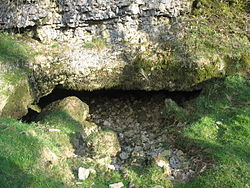
Pate Hole is a solutional cave located adjacent to Asby Gill 1 kilometre (0.62 mi) south of Great Asby in Cumbria, England. It is 970 metres (3,180 ft) long and has a vertical range of 33 metres (108 ft). The entrance is normally dry, but in flood it becomes an impressive resurgence. Its name derives from the north country word for badger.
It consists of three main passages. From the entrance a stooping height passage heading south-east reaches a large 6 metres (20 ft) deep pool after 330 metres (1,080 ft) from which a stream emerges. This flows down a low passage to the north for some 270 metres (890 ft) where a sump is reached. The third main passage continues south underwater from the pool for 225 metres (738 ft) at a depth of 27 metres (89 ft) where it reaches a junction and becomes too restricted.
The cave is formed in Carboniferous limestone, and is thought to drain the Great Asby Scar area 3 kilometres (1.9 mi) to the south-west. The resurgence is presumed to be St. Thomas's Well in Great Asby.
The main part of the cave has been known for a long time, and it was an object of curiosity in the nineteenth century. A brief foray into it was described in The Gentleman's Magazine in 1791, and a description appeared in The Monthly Magazine in 1802. The first full description complete with passage lengths appeared in 1813. The first account of an exploration by cavers was in 1941 by members of the Yorkshire Ramblers' Club, and in November 1946 it was surveyed by a group from Appleby Grammar School led by Brian Price. The upstream sump was first dived for about 10 metres (33 ft) to a descending rift in 1960 by members of the Cave Diving Group, at which time the main part of the cave was re-surveyed by Warburton et alia. Further exploration took place in 1975-1976 by members of the same group to reach the current limit.

1.3 km
Great Asby
Great Asby is a village in Cumbria, England. Historically part of Westmorland, it is located approximately 15 miles (24 km) south east of Penrith and approximately 5 miles (8.0 km) south of Appleby-in-Westmorland. Its name is said to be derived from the Old Norse: askr, meaning ash and by, meaning farm.
In present times the village is used mainly by the farming community.
The village's church is St Peter's Church, which was built between 1863 and 1866.

1.9 km
Settle–Carlisle line
The Settle–Carlisle line (also known as the Settle and Carlisle (S&C)) is a 73-mile-long (117 km) main railway line in northern England. The route, which crosses the remote, scenic regions of the Yorkshire Dales and the North Pennines, runs between Settle Junction, on the Leeds–Morecambe line, and Carlisle, near the English-Scottish borders. The historic line was constructed in the 1870s and has several notable tunnels and viaducts such as the imposing Ribblehead.
The line is managed by Network Rail. All passenger services are operated by Northern apart from temporary diverted services (due to closures of the West Coast Main Line) and are part of the National Rail network. Stations serve towns such as Settle in North Yorkshire, Appleby-in-Westmorland in Cumbria and small rural communities along its route.
In the 1980s, British Rail planned to close the Settle–Carlisle line. This prompted a campaign to save the line by rail groups, enthusiasts, local authorities and residents along the route. In 1989, the UK government announced the line would be saved from closure. Since then, passenger numbers have grown steadily to 1.2 million in 2012. Eight formerly closed stations have been reopened and several quarries have been reconnected to the line. It remains one of the most popular railway routes in the UK for charter trains and specials. After damage by a landslip, part of the line was closed from February 2016 to March 2017. To celebrate the reopening, the first regular mainline scheduled service in England for nearly half a century ran with a steam engine.

2.9 km
Little Asby
Little Asby is a small village in Cumbria, England. Historically part of Westmorland, its name is said to be derived from the Norse words askr, meaning "ash", and by, meaning "farm". A chapel at the site (St Leonard's Chapel), of which little remains, is the main reason that the village was built.
Just outside the village, to the west, is Little Asby Common, which is a Site of Special Scientific Interest and a Special Area of Conservation because of the plant species that inhabit the limestone pavement areas, as well as the limestone geology of the area. In chronostratigraphy, the British sub-stage of the Carboniferous period, the 'Asbian' derives its name from Little Asby Scar.