

 English
 Français

Euxton
Euxton est une ville et une paroisse civile anglaise située dans le comté du Lancashire. En 2001, sa population était de 8 318 habitants.
Nearby Places View Menu
73 m
Euxton
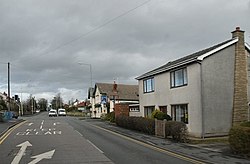
Euxton ( EKS-tən) is a village and civil parish in the Borough of Chorley, Lancashire, England. The population at the 2011 census was 9,993, but is now estimated to be around 14,000 due to housing developments in the village, including at Buckshaw. The village is just to the west of Chorley, and south of Clayton-le-Woods.
Euxton covers an area around 2.5 miles (4.0 km) from east to west and 2 miles (3.2 km) north to south. The village is made up of several areas including Runshaw Moor, Balshaw, Shaw Green, Daisy Hill, Buckshaw, Pincock, Primrose Hill, Glead Hill, Dawbers, Spout Hillock, Culbeck and Pear Tree.
The boundaries of Euxton have remained largely unchanged, as they follow a series of natural waterways. The northern boundary is formed by Worden Brook, which runs through the centre of Buckshaw Village and becomes Shaw Brook, marking the border between Euxton and Leyland. To the east, the boundary was historically defined by German Brook and German Lane (now Washington Lane), whereas the boundary is now broadly aligned with West Way. The southern boundary is formed by the River Yarrow, while to the west, the parish boundary follows historic field lines from Runshaw Moor southwards to the point where the A581 changes from Dawbers Lane to Southport Road near the Elephant Restaurant and on to the Yarrow.
Euxton is served by five primary schools: Balshaw Lane Primary, Primrose Hill Primary, Euxton C of E Primary, Euxton RC Primary and Trinity C of E/Methodist Primary School.

148 m
Euxton Hall Chapel
Euxton Hall Chapel is situated in the village of Euxton, Lancashire, England. It was designed by architect E. W. Pugin (1834–1875), and built in 1866 as a private chapel for the Anderton family. Set within the grounds of Euxton Hall, and a Grade II listed building within its own right, the small Gothic chapel has been described as an architectural gem. Both English Heritage and the Ancient Monuments Society acknowledge that it is one of the important works of this architect. The Victorian Society has also recognised the building's national importance.
Of particular interest is the large stained glass window manufactured by Hardman & Co., set in the west wall and dated 14 October 1866. It incorporates the coat of arms of the Anderton family, which is repeated in the encaustic floor tiles of the centre aisle. Herbert Minton, the first manufacturer to produce these tiles in 1830, worked closely with Pugin in their design and manufacture for numerous buildings, notably the Palace of Westminster.
In 1866, the architectural period of the Gothic Revival was at its peak, and Euxton Hall Chapel, having been designed by Pugin, was arguably one of the finest Victorian chapels to be found in England. The exterior of the chapel is almost entirely Pugin. The South front has three pairs of lancet window, a typical medieval feature, with each arch having a pair of intricate detailed carvings. The shaped slate tiles on the roof of the Chapel form geometric patterning, a feature also associated with the work of Pugin. In 2004 the chapel was majorly restored by conservationist Andrew Gray and converted by him to a private residence.

277 m
Euxton Balshaw Lane railway station
Euxton Balshaw Lane is one of two railway stations situated in Euxton , Lancashire, England. It is a local station on the Blackpool North to Liverpool Lime Street route, on the stretch between Wigan and Preston.

282 m
Euxton Parish Church
Euxton Parish Church is in the English village of Euxton in the borough of Chorley, Lancashire. It is an active parish church in the Diocese of Blackburn and the archdeaconry of Blackburn. It is recorded in the National Heritage List for England as a designated Grade II* listed building.
The church has a seating capacity of 191.
591 m
Euxton railway station (London and North Western Railway)
Euxton was an early railway station serving Euxton in Chorley, Lancashire, England.
The station was opened on 31 October 1838 when the North Union Railway opened its line from Wigan to Preston.
The station was located to the north of Euxton where Know Lane crossed the railway, between Know House and the Bay Tree Inn. The station comprised a single platform with a station house to the east side of the railway. By 1894 there were two buildings on the east side of the line, platforms on both sides of the railway with some smaller structures on the north-bound platform. There did not appear to be any goods facilities.
The station closed on 2 September 1895. The London and North Western Railway (LNWR) replaced Euxton with a new station, Balshaw Lane and Euxton, opening on the same day located 3⁄4 mile (1.2 km) south of the original Euxton station. The NUR was absorbed by two larger companies in 1889, the section from Parkside to Euxton became part of the L&NWR.
The line remains open between Preston and Wigan, however nothing remains of the station.