

 English
 Français

Port Glasgow
Port Glasgow (Port Ghlaschu en gaélique écossais) est la deuxième plus grande ville du Council Area d'Inverclyde en Écosse. Elle est située à l'est de Greenock et a été un burgh dans l'ancien comté du Renfrewshire. La ville s'est développée depuis un centre historique bien conservé. Elle s'est ensuite étendue sur les falaises en occupant les terrains d'anciens villages comme Boglestone et Devol. Cette zone urbaine est désormais appelée upper Port Glasgow (la ville haute). C'est la zone la plus peuplée.
Nearby Places View Menu

600 m
Town Buildings, Port Glasgow
The Town Buildings, also known as the Municipal Buildings, are in Fore Street, Port Glasgow, Scotland. The structure, which served as the meeting place of Port Glasgow Burgh Council, is a Category A listed building.

668 m
Port Glasgow
Port Glasgow (Scottish Gaelic: Port Ghlaschu, pronounced [pʰɔrˠʃt̪ˈɣl̪ˠas̪əxu]) is the second-largest town in the Inverclyde council area of Scotland. The population according to the 1991 census for Port Glasgow was 19,426 persons and in the 2001 census was 16,617 persons. The most recent census in 2011 states that the population has declined to 15,414. It is located immediately to the east of Greenock and was previously a burgh in the county of Renfrewshire.
Originally a fishing hamlet named Newark, Port Glasgow came about as a result of large ships being unable to navigate the shallow and meandering River Clyde to the centre of the city of Glasgow. Because of this, it was formed as a remote port for Glasgow in 1668 and became known as 'New Port Glasgow', which was shortened to 'Port Glasgow' in 1775. Port Glasgow was home to dry docks and shipbuilding beginning in 1780.
The town grew from the central area of the present town and thus many of the town's historic buildings and people are found here. Port Glasgow expanded up the steep hills inland to open fields where areas such as Park Farm, Boglestone, Slaemuir and Devol and Oronsay were founded. This area has subsequently become known as upper Port Glasgow and most of the town's population occupies these areas.

723 m
Port Glasgow railway station
Port Glasgow railway station is on the Inverclyde Line, serving the town of Port Glasgow, Scotland. It is located in the town centre with the main entrance at the junction of Princes Street and John Wood Street.
It opened on 31 March 1841, being one of the intermediate stations on the Glasgow, Paisley and Greenock Railway which opened on that date. It later became a junction in 1865, when the branch to Wemyss Bay was opened. The main line was then extended to Gourock in 1889 by the Caledonian Railway.
The two lines diverge to the west of the station, with the Wemyss Bay branch now mostly single track all the way to the terminus; the Gourock line is double throughout. Both lines were electrified in 1967 by British Rail using the 25 kV AC system, with the branch partially singled as part of the modernisation work. A (now disused) connection to the former Glasgow and South Western Railway station at Greenock diverged from the branch line a short distance west of the junction. The old station was used for a period (circa 1971–84) as a container terminal but was officially closed in September 1991.
There was a bay platform at the west end of the station for services to Wemyss Bay. The platform was located on the south side of the line and is now infilled – prior to electrification, it was used for carriages which were added to (and on return detached from) Wemyss Bay trains.
967 m
Newark Castle, Port Glasgow
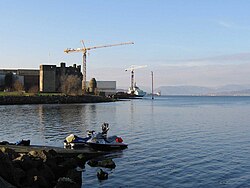
Newark Castle is a well-preserved castle sited on the south shore of the estuary of the River Clyde in Port Glasgow, Inverclyde, Scotland, where the firth gradually narrows from the Firth of Clyde and navigation upriver is made difficult by shifting sandbanks. For centuries this location was used to offload seagoing ships, and led to the growth of Port Glasgow close to the castle on either side and to the south. When dredging techniques made the Clyde navigable as far as Glasgow the port became a shipbuilding centre, and the castle was surrounded by shipyards. Ferguson Shipbuilders, the last shipyard on the lower Clyde, stands close to the west of the castle, but the shipyards to the east were removed around the 1980s and new landscaped areas formed to the east of Newark Castle, opening up scenic views of the castle and across the Clyde from a new bypass road.

988 m
Bogston
Bogston (Scots: Bogstoun, Scottish Gaelic: Baile na Fèithe) is an area of the towns of Port Glasgow and Greenock in the council area of Inverclyde, Scotland. It is 35 km (21¾ miles) west of Glasgow.
The area is served by Bogston railway station.