

 English
 Français

College Green is an open space in the city centre of York, England.
Nearby Places View Menu

23 m
Old Residence
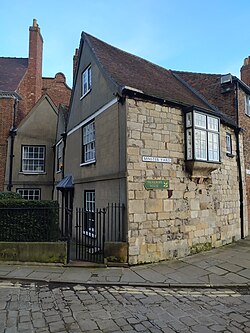
Old Residence is a historic building in the English city of York, North Yorkshire. A Grade II* listed building, located at 6 Minster Yard, at its junction with College Street, it dates to the early 18th century, but it was raised and reroofed in 1786, as well as receiving a small extension in the late 19th century.
The building stands about 30 feet (9.1 m) from York Minster's southeastern corner.

32 m
St William's College
St William's College is a Mediaeval building in York, England, originally built to provide accommodation for priests attached to chantry chapels at nearby York Minster. It is a Grade I listed building.
The college was founded in 1460 by George Neville and the Earl of Warwick to house 23 priests and a provost. It was named after St William of York.
In 1465, work started on the present building. This courtyard structure may incorporate parts of two earlier houses. It included a great hall to the north, with a chapel to its east. The hall survives in part, but its ceiling has been lowered and the plasterwork was replaced in 1910. The posts of a screens passage also remain, the other side of which is the fireplace of the original kitchen. It has been suggested that doorways led off the courtyard to staircases, with rooms for the provost and fellows of the college leading off them.
While the college was not a monastic establishment, it was affected by the Dissolution of the Monasteries, as in 1548, the building was converted to a substantial house, with later tenants including Charles Howard, 3rd Earl of Carlisle. Around this time, a single main staircase was added, which survives, while a room to the south-west has remains of wall paintings from this era. In the 17th century, the "Bishop's Chamber" was created on the first floor, to the west of the great hall, and it survives largely intact. In the 18th century, part of the ground floor was used for retail, and bow windows were added, which still survive. Otherwise, the façade generally survives as built, with an ashlar ground floor and a timber-framed, jettied upper floor. The doorway itself is a replacement, but the coats of arms above are from about 1670, and carvings of Saint Christopher and the Virgin and Child either side of the entrance also survive.
39 m
5 Minster Yard
5 Minster Yard is a Grade II* listed building in the city of York, North Yorkshire, England.
The building is wholly timber-framed and is located with its south side facing Minster Yard. It originated as part of a two-storey row of tenements, built about 1300, the row also having included what is now 2 College Street. From this period survive parts of some roof trusses and a rafter. The main range may have been rebuilt in about 1500. In about 1600, a large chimney stack was added, with a new staircase to its north, and a two-storey wing was added on the north side of the building.
The building was heavily altered in 1891, with its south wall rebuilt in stone, including a prominent oriel window. The west gable end was also rebuilt on a new alignment, and a third storey was added to the eastern half of the building. Internally, an entrance hall was created, and a new staircase added, reusing balusters from about 1700. The western first floor room has a fireplace surround and panelling dating from about 1600, and the eastern ground and first floor also have wooden panelling.
The building was listed in 1954, along with its garden railings and gate posts.

42 m
30–32 Goodramgate and 11–12 College Street
30 and 32 Goodramgate and 11 and 12 College Street is a Grade II* listed building in the city centre of York, in England.
The building lies on the corner of Goodramgate and College Street. The part facing College Street was constructed in the early 14th century, while the part facing Goodramgate was constructed in the 1380s or 1390s as part of a terrace of houses, replacing a large stone house which belonged to John le Romeyn. The structure also includes a gatehouse which is believed to represent an entrance to the Mediaeval Minster Close, but which was completely rebuilt about 1600. The main parts of the building were altered in the 18th and 19th centuries, when much of the timber was replaced with brickwork.
By 1752, part of the building was in use as the Angel Inn. The Goodramgate façade is of two storeys and four bays, and includes a double-storey gatehouse built in the 18th century. The ground floor of the entire building is currently in use as shops and cafes, with part occupied by the National Trust. It was listed at Grade II* in 1954.