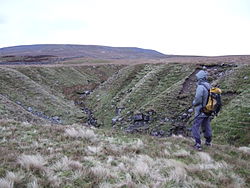
Masongill is a small community on the western edge of the county of North Yorkshire, England. The village, in the Yorkshire Dales, lies near the border of Lancashire to the west, and the nearby hamlet of Ireby. Until 1974 it was part of the West Riding of Yorkshire. From 1974 to 2023 it was part of the district of Craven. It is now administered by the unitary North Yorkshire Council. St Mary's Church, Ingleton, contains a memorial to one Randall Hopley Sherlock (brother of the vicar, Todd Sherlock) struck and killed by lightning at Ingleton station), and several locations in the area include the word Holme. Mary Doyle (mother of Arthur Conan Doyle) lived in Masongill from 1882 to 1917, and Conan Doyle (creator of Sherlock Holmes) was a frequent visitor. So some do wonder if the name of Sherlock Holmes came from Masongill. Doyle would have arrived by train at Ingleton (Midland) railway station and continued his journey to Masongill by cart. This would have taken him through Holme Head, below Ingleton Viaduct. Doyle married his first wife in 1885 at nearby St Oswald's Church, Thornton in Lonsdale. Another person of interest in the history of Masongill is Bryan Charles Waller (1853–1932). Waller was Squire of Masongill from 1877 and, from 1879, he was a lecturer in Pathology at the University of Edinburgh, having already attained his MD there. During his time in Edinburgh he took lodgings with the Doyle family and quickly became a dominant factor in their lives. It was he who persuaded Conan Doyle to train as a doctor, and his mother to come and live in Masongill.

Doyle and Waller were big men with strong characters and their relationship deteriorated to such an extent that they came to blows. Waller was only 6 years older than Doyle, so 15 years younger than Mary. Also, Waller married in August 1896. Nevertheless, Mary Doyle remained as tenant of Masongill Cottage until 1917, when she moved south. She preferred the regular company of Waller to the irregular companionship of her son.

1. References


1. External links

Media related to Masongill at Wikimedia Commons

Nearby Places View Menu
Location Image
887 m

Ireby, Lancashire

Ireby is a small hamlet and civil parish on the edge of Lancashire, England, bordering North Yorkshire. It lies in the City of Lancaster, just inside the recently extended boundaries of the Yorkshire Dales, near the community of Masongill. The parish had a population of 78 according to the 2001 Census. In the 2011 census the parish was grouped with Leck. The name means "Town of the Irish Vikings".
Location Image
2.0 km

Leck Hall

Leck Hall is an 18th-century country house located at Leck, Lancashire, England, near Kirkby Lonsdale. The hall is grade II listed. and stands in an informal park with an orangery nearby. Home farm, late 18th century, is close to the house and there is a Lodge at the entrance to the drive. It is the current seat of Baron Shuttleworth, of Gawthorpe Hall, Padiham in the County Palatine of Lancaster (Lancashire) and is not open to the public.
Location Image
2.2 km

Hipping Hall

Hipping Hall was a country house hotel on the border of Lancashire, Cumbria and North Yorkshire, near Kirkby Lonsdale. In 2005, chemist-turned-hotelier Andrew Wildsmith, opened a five-star retreat with nine bedrooms and a Four-AA Rosette restaurant serving a menu of locally sourced food. In Autumn 2010, Hipping Hall featured in an episode of BBC2’s The Trip – a series starring Steve Coogan and Rob Brydon, in which the pair embark on a restaurant tour of northern England. On the 24th July 2023, the hotel and restaurant closed.
Location Image
2.3 km

Ireby Fell Cavern

Ireby Fell Cavern is a cave system on Ireby Fell, Lancashire, England, near the border with North Yorkshire. It is a segment of the Three Counties System, linking the Rift Pot system to the south with Notts Pot to the north. This popular cave starts with a pitch series that eventually opens out into a very large series of dry sandy passages. The entrance is a vertical concrete pipe at the bottom of a shakehole that was last shored up in 2006. The traditional route is down three pitches (Ding, Dong, and Bell), but there are several alternative routes. All may become impassable in wet weather. After many metres of rift passage is Well Pitch which accesses the main lower sandy passages known as Duke Street. At the far end of Duke Street is Whirlpool chamber where a short sump (not free-diveable) gave access to cave divers into further passages known as Ireby II. In early 2007, a system involving a primitive hand pump and a mud dam to temporarily retain the water in an artificial lake in Duke Street allowed non-divers to enter this part of the cave. This facilitated the digging out of a passage in the roof of Whirlpool Chamber previously blocked by sand, to be dug out from both ends hence creating a bypass to the sump. Digging has also forged a dry bypass to the sump via the aptly named Cripple Creek.