Raploch, known locally as The Raploch or The Raptap, is a district of the city of Stirling, which lies to the south of the River Forth in central Scotland. The first houses were built in the late 17th century, after the land had been sold by the Earl of Mar to the patrons of Cowane's Hospital in Stirling. Economic conditions led to stagnation but housing began again in earnest at the start of the 19th century. The real expansion came in the middle of the 20th century, when council housing replaced decrepit housing in the old town. The Raploch was the subject of a 2002 BBC Scotland documentary entitled Raploch Stories, and in a 2017 sequel Raploch Stories Revisited. Since 2004, the Raploch area has undergone a great deal of physical regeneration, overseen by the Raploch Urban Regeneration Company. The Scottish government has praised Raploch's masterplanning as an example of good practice. Conditions which ensured access to training and employment for previously long-term unemployed workers in regeneration work have also been well-received. In 2008 the area became the home of the UK's first El Sistema children's orchestra, called Big Noise Raploch. A children's orchestra with over 100 members, who performed with Gustavo Dudamel and the Simón Bolívar Symphony Orchestra of Venezuela on 21 June 2012 and on a BBC Scotland Christmas Eve (2012) Special in Stirling's Holy Rude Church. After the Second World War, there were great efforts to develop Stirling's housing including at Raploch by the Scottish Special Housing Association.

Lieux à Proximité Voir Menu
Location Image
347 m

Mote Hill

Mote Hill is the northern tip of the Gowanhills, Stirling, the northern half of the Royal Park that extends around Stirling Castle. The wider park includes the King's Knott and sections of a 2-metre-high deer wall, first established in the 12th century, though Gowan Hill only became park of the Royal Park around 1500. Ten thousand years ago, Mote Hill was a promontory projecting into a lost prehistoric sea. On the opposite bank of the River Forth lies Abbey Craig, upon which sits the National Wallace Monument. These two rocky outcrops were, for thousands of years, the lowest crossing point of the Forth. Mote Hill is also known as Heiding Hill or Murdoch's Knowe or Hurlie Haw and is the location of the Beheading Stone, the traditional execution block of medieval Stirling. The stone itself is now on a concrete mount and under an iron cage, but you can still see the axe marks from the executions. Mote Hill is also the site of a vitrified fort, destroyed by fire in the first half of the first millennium AD. This date was confirmed by excavation by Dr Murray Cook, Stirling Council's archaeologist.
Location Image
647 m

Stirling Castle

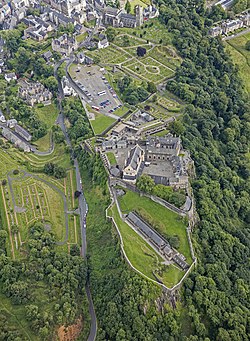
Stirling Castle, located in Stirling, is one of the largest and most historically and architecturally important castles in Scotland. The castle sits atop an intrusive crag, which forms part of the Stirling Sill geological formation. It is surrounded on three sides by steep cliffs, giving it a strong defensive position. Its strategic location, guarding what was, until the 1890s, the farthest downstream crossing of the River Forth, has made it an important fortification in the region from the earliest times. Most of the principal buildings of the castle date from the fifteenth and sixteenth centuries. A few structures remain from the fourteenth century, while the outer defences fronting the town date from the early eighteenth century. Before the union with England, Stirling Castle was also one of the most used of the many Scottish royal residences, very much a palace as well as a fortress. Several Scottish Kings and Queens have been crowned at Stirling, including Mary, Queen of Scots, in 1542, and others were born or died there. There have been at least eight sieges of Stirling Castle, including several during the Wars of Scottish Independence, with the last being in 1746, when Bonnie Prince Charlie unsuccessfully tried to take the castle. Stirling Castle is a Scheduled Ancient Monument, and is now a tourist attraction managed by Historic Environment Scotland.
Location Image
728 m

Statue of Robert the Bruce, Stirling Castle

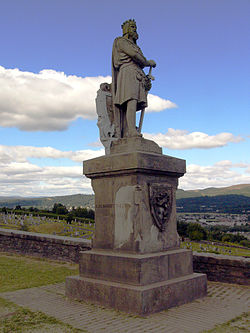
The statue of Robert the Bruce on the esplanade at Stirling Castle, Stirling, is a 1876 work sculpted by Andrew Currie and designed by illustrator George Cruikshank. As of 2020, the statue is featured on the Clydesdale Bank £20 note.
Location Image
748 m

Battle of Stirling (1648)

The second Battle of Stirling was fought on 12 September 1648 during the Scottish Civil War of the 17th century. The battle was fought between the Engagers who were a faction of the Scottish Covenanters under the command of George Munro, 1st of Newmore and who had made "The Engagement" with Charles I of England in December 1647, against the Kirk Party who were a radical Presbyterian faction of the Scottish Covenanters who were under the command of Archibald Campbell, 1st Marquess of Argyll.