Location Image

West Cliff, Preston

West Cliff is a cricket ground in Preston, Lancashire. The first recorded match on the ground was in 1870, when Preston played a United North of England Eleven. In 1936, the ground held its first first-class match when Lancashire played Gloucestershire. From 1936 to 1939, the ground played host to 4 first-class matches involving Lancashire, the last of which saw them play Glamorgan. In 1952, Lancashire returned to the ground where they played a single first-class match against Glamorgan. The ground has also played host to a combined total of 15 Second XI fixtures for the Lancashire Second XI in the Minor Counties Championship, Second XI Championship and Second XI Trophy. Still in use to this day, in local domestic cricket the ground is the home venue of Preston Cricket Club who play in the Palace Shield.

Nearby Places View Menu
Location Image
249 m

Park Hotel, Preston

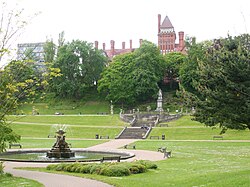
The Park Hotel was a railway-owned hotel at East Cliff, Preston, Lancashire, England, used for many years as offices, but now being restored as a hotel. The hotel opened in 1883 and was operated jointly by the Lancashire and Yorkshire Railway and London and North Western Railway. In the 1923 grouping of railway companies, ownership passed to the London, Midland and Scottish Railway. When the UK's railways were nationalised in 1948, it passed to the British Transport Commission's Hotels Executive, and thence to British Transport Hotels, who sold it in 1950. It has subsequently been, and as of September 2014 remains, used as offices, and renamed "East Cliff County Offices", by Lancashire County Council, who also had a modern annexe, adjacent. Located on a small hill, the red-brick building overlooks Preston railway station, on the West Coast Main Line, to its north-west and Miller Park and the River Ribble to its south-east. In its heyday, the hotel was connected to the southern end of the main south-bound platform (the modern-day platform 4) at Preston station by a covered footbridge Various pre-1923 objects from the hotel are in the National Railway Museum at York. These include Mappin & Webb cutlery and Elkington & Co. tableware and candlesticks, the latter marked with the initials "P.P." and a lamb and flag, the coat of arms of the city. The historic hotel structure was used for many decades as an office building for the Lancashire County Council, along with an adjoining tower block, constructed in the 1960s. In 2020, the tower block was demolished as part of a plan by the Council to restore the hotel to operation.
Location Image
316 m

Miller Park, Preston

Miller Park is a public park under the management of Preston City Council. It is located on the banks of the River Ribble in Preston, Lancashire, in the north west of England. The park is one of two city centre Victorian era parks, the other being the adjacent and larger Avenham Park.
456 m

Preston Fishergate Hill railway station

Preston Fishergate Hill was a railway station at the bottom of Fishergate Hill in Preston. It formed the northeastern terminus of the West Lancashire Railway which built a direct railway link between Southport and Preston. The station was also known as Preston West Lancashire Station (OS 1:2500 1st Ed map).
Location Image
478 m

Penwortham Old Bridge

Penwortham Old Bridge is a toll-free, five-span bridge over the River Ribble at Preston, Lancashire, England. A Grade II listed structure and a scheduled monument, located about a mile southwest of the centre of the city, it crosses the river to Penwortham. Today the bridge no longer carries motorised traffic. The original attempt to build a bridge here was completed in 1755, but collapsed the following year. The bridge is built in stone and consists of five unequal segmental arches, rising toward the centre. The cutwaters rise to form refuges at the sides of the carriageway. The spandrels are of red sandstone. The parapets curve to form walls on the south side, extending approximately 40 metres (130 ft) eastwards and 130 metres (430 ft) westwards. The largest arch is the central one at 18.19 metres (59.7 ft) across and the cobbled carriageway is 5.49 metres (18.0 ft) wide. On the northern side a sixth arch, aligned almost at a right angle to the main part of the bridge, carries the approach road from the west. Opening in 1759, until the early 20th century this was lowest bridged crossing over the Ribble. Its costs have at times been funded by a toll. The bridge was Grade II listed in two stages, the part at the southern end (then within the Preston Rural District) on 1 October 1962, and remaining part (in Preston) on 27 September 1979. It has also been listed as a scheduled monument.