

 English
 Français

Drumelzier
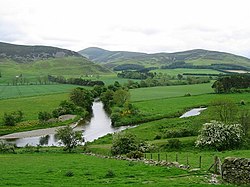
Drumelzier (), is a village and civil parish on the B712 in the Tweed Valley in the Scottish Borders. The area of the village is extensive and includes the settlements of Wrae, Stanhope, Mossfennan and Kingledoors. To the north is Broughton and to the south the road passes Crook Inn to Tweedsmuir. Powsail Burn (also called Drumelzier Burn) runs through Drumelzier to become a tributary of the River Tweed. Stobo Castle hotel and health spa are in the area, as is Dawyck Botanic Garden, one of three "Regional Gardens" of the Royal Botanic Garden Edinburgh.
Nearby Places View Menu
1.1 km
Biggar Water
Biggar Water is a river in Lanarkshire and Peeblesshire, in the Southern Uplands of Scotland.
It forms part of the River Tweed system. It rises, as Biggar Burn, in the north-east of the parish of Biggar, South Lanarkshire and flows about 6+3⁄4 miles (10.9 km) generally south-westerly toward the town of Biggar, where it becomes Biggar Water. It then flows about 5 miles (8.0 km) eastwards before its confluence with the Tweed 3⁄4 mile (1.2 km) mile north-east of Drumelzier in Peeblesshire.

1.7 km
Dreva on Tweed
Dreva on Tweed (or simply Dreva) is a hamlet in the Scottish Borders. It was historically in Peebles-shire.
It is noted for the historical presence of a Peel tower.

1.9 km
Holms Water
The Holms Water is a river and a tributary of the Biggar Water, which is a tributary of the River Tweed, in the parish of Broughton, Glenholm and Kilbucho in the Scottish Borders area of Scotland, near Glenkirk, Stanhope, Peeblesshire and Hearthstane.

2.3 km
Wrae Tower
Wrae Tower is a ruined 16th-century stone tower house, located in the upper Tweed Valley in the Scottish Borders area of Scotland, and similarly south of the village of Broughton. The ruin is at grid reference NT115332, 3 km south-west of Drumelzier. Only a fragment of the north-east corner stair tower, around 9m high and 4m across, remains standing. A single jamb represents the north-west ground floor entrance to the tower and crowning the north-east wall is rough corbelling, which supports the remains of a parapet. The tower was probably built by the Tweedies of Drumelzier, who owned the surrounding lands since 1320.