Liverton is a village in the civil parish of Loftus, in the borough of Redcar and Cleveland and the ceremonial county of North Yorkshire, England. Liverton Village is named in Domesday Book and was previously named Liureton, it is a rural village that has by and large retained its heritage as a farming community and in 1978 became protected by a conservation order. In 2011 an Area Appraisal was performed. The village is surrounded by a field system with Station Road B1366 running through the middle. The village can date its roots back to the 12th century, with evidence of this seen from the font, arch and doorway of St Michael's Church. There is further evidence of a medieval settlement in area. It is located 140 meters above sea level and is located on the edge of the North Yorkshire Moors.

Nearby Places View Menu
Location Image
1.4 km

Handale Priory

Handale Priory (also called Grendale) was a priory of Cistercian nuns in Handale, North Yorkshire, England. It was founded in 1133 by William, son of Roger de Percy, and was dissolved in 1539. A fishpond survives and a farmhouse built on the site in the 18th century may incorporate part of the priory.
Location Image
1.4 km

Handale

Handale is a hamlet, that is 2 miles (3 km) south of Loftus, in the borough of Redcar and Cleveland and the ceremonial county of North Yorkshire, England. Handale was once the site of a Cistercian nunnery, founded in 1133. There is a legend that the woods in the area were once the haunt of a dragon known as the Handale Serpent. It is said that the dragon was slain by a man named Scaw, after whom Scaw Wood is named.
1.6 km

Liverton Mines

Liverton Mines is a village in the unitary authority of Redcar and Cleveland and the ceremonial county of North Yorkshire, England. It is surrounded by large, local towns Middlesbrough, Redcar, Guisborough and Whitby. The village has a shop (Charlie's), a post office, a fish and chip shop, church and a pub.
Location Image
1.9 km

Kilton Castle

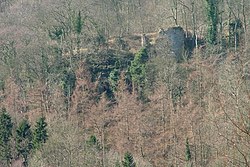
Kilton Castle is a ruined castle overlooking the valley of Kilton Beck, near to the village of Kilton in the historic county of the North Riding of Yorkshire (now Redcar and Cleveland) in England. The castle was built in the 12th century and was described as being in a ruinous state by the 14th century, with it being totally abandoned by the 16th century. Kilton Castle was owned by several noble families who hailed from the area; de Brus, de Kilton, Autrey, de Thweng, de Lumley. The setting of the castle on a promontory above the valley meant that it had slopes leading up to three sides and a fourth side (to the west) had a narrow entrance into the valley wall. Due to its commanding position and man-made and natural defences, it has been labelled the "most powerful baronial fortress in Cleveland." Its rebuilding in stone in the late 12th century was accomplished without need of a keep, which has led to it being known as the first castle in the north of England to be keepless.