


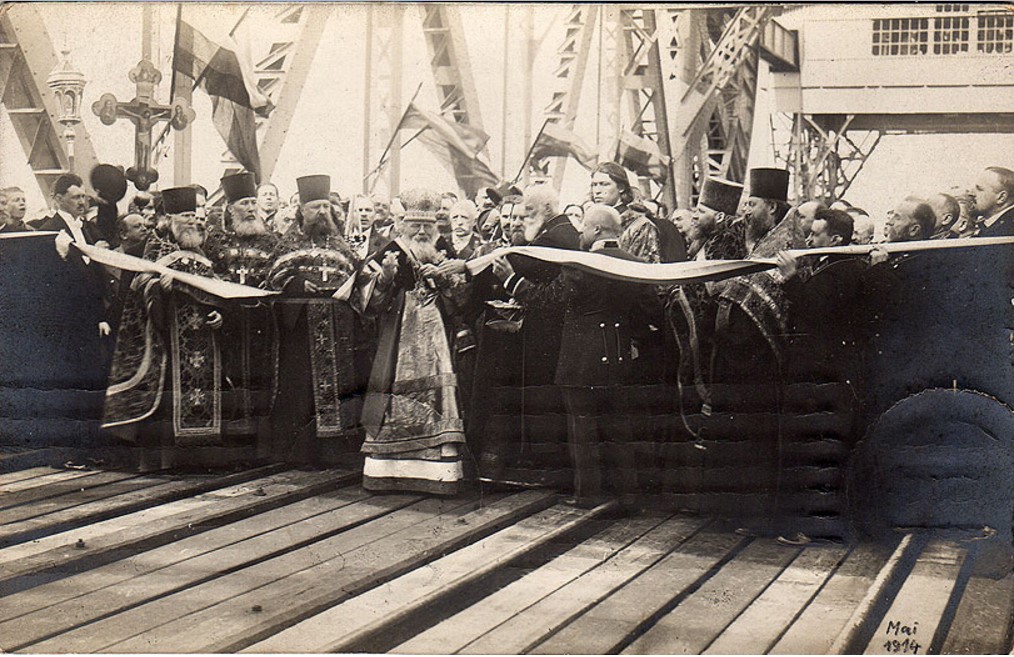
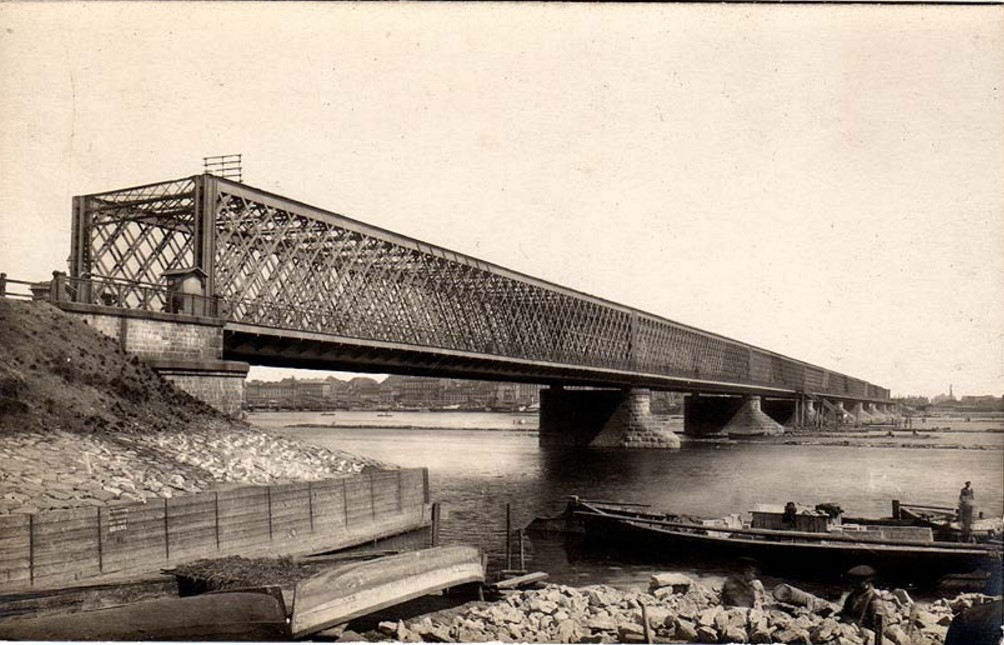
The Railway Bridge (Latvian: Dzelzceļa tilts) is a bridge that crosses the Daugava river in Riga, the capital of Latvia. The first iron railway bridge in Riga, over 600 ftm long, was erected in 1871–1872 for the Riga–Jelgava Railway. The new bridge was inaugurated 1914, shelled twice, during World War I in 1917 and World War II in 1944, and was rebuilt both times.
Gallery


Sponsored
Location
1 explorer visited this place

22 m
The Iron Bridge or Semigallia Bridge was a bridge that crossed the Daugava river in Riga, the capital of Latvia. It was built in 1871–72. The bridge was bombarded twice, during World War I and World War II, and was not rebuilt after the latter war. The only remains of the bridge are its pillars in the river.

375 m
The Dannenstern House is a historical building in the Old town of Riga, Latvia.
The house was built by and is named after Ernst Metsue von Dannenstern, a wealthy merchant. It dates from 1696 and is considered one of the finest examples of Baroque architecture in Riga. It was designed by German architect and chief architect of Riga Rupert Bindenschu. The street facade, in limestone, has giant order Corinthian pilasters and two elaborate entrance portals, created by sculptor D. Walter. The building also contains fragments of an earlier, medieval building.

424 m
Stone Bridge is a bridge over the Daugava River in Riga, Latvia. It was called the October Bridge until 1992.
433 m
On August 13, 1950, the paddle steamer Mayakovsky sank at around 12:00 pm local time due to overloading of the vessel with too many people. The vessel's capacity was 150 people, but at the time of the disaster there were 421 people on board. Mayakovsky sank in the Daugava River that bisects Riga, not more than 15 metres from the present day site of the Stone Bridge. A total of 147 people died, including 48 children. It was the deadliest peacetime disaster in Soviet Latvian history. At the time, Latvia was a republic within the Soviet Union, under the rule of Joseph Stalin, and news of the disaster was not published in the state-controlled press. On August 19, 2011, almost 20 years after the breakup of the Soviet Union and Latvia regaining its independence, a memorial plaque was dedicated at the Stone Bridge in memory of the victims.
460 m
The 1998 Riga bombings were a series of bombings that took place in Riga, Latvia and which received considerable coverage at the time, most notably for their connection with fascist groups and the perception of an increase of fascism in Latvia. The United States government offered to help to locate the suspects, calling the acts "cowardly," and then-Latvian Prime Minister Guntars Krasts condemned the bombings, calling them an attempt to destabilize the country.
At 1:50 am on April 2 a bomb exploded in Riga's old town outside the 92-year-old Peitav Synagogue, the only surviving working synagogue in the city, causing severe damage to the building and surrounding area. The bomb, which was supposedly planted by fascist extremists, was reportedly placed on the front steps of the synagogue building. The bomb caused extensive damage, including tearing out the 90 kg oak door, destroying all the windows and casings of the basement and first and second floors, and leaving deep gouges in the wall. There were no casualties.
Four days after the April 2 bombing, another explosion caused damage to the Russian Embassy in Riga. As with the April 2 explosion, there were no injuries. The cause of the blast was plastic explosives detonated in a trash bin. The attack was linked with a rise in nationalist and extremist actions that seriously unsettled relations among Latvians, Jews and Russians. Alexander Udaltsev, Russia's ambassador to Latvia, joined Latvian leaders in blaming the incident on those trying to drive a wedge between Russians and Latvians. The Russian Foreign Ministry controversially blamed the bombing outside its Riga embassy on "anti-Russian hysteria recently produced in Latvia and the encouragement of nationalism and extremism" and called for drastic measures to punish those who were guilty.
A few days after the Riga bombings, a monument to Latvian victims of the Holocaust was defaced in the port town of Liepāja.
The bridge is nowadays the only railway bridge in Riga. The bridge will be duplicated as part of the new Rail Baltica line through Riga.