


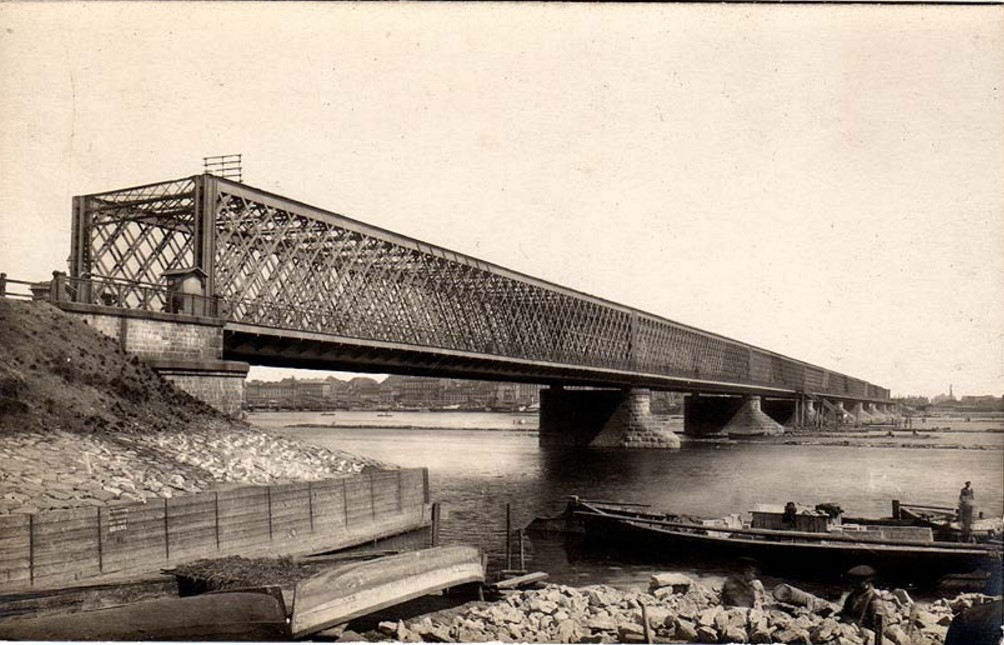
The Iron Bridge (Latvian: Dzelzs tilts) or Semigallia Bridge (Zemgales tilts) was a bridge that crossed the Daugava river in Riga, the capital of Latvia. It was built in 1871–72. The bridge was bombarded twice, during World War I and World War II, and was not rebuilt after the latter war.
Gallery
Sponsored
Location
1 explorer visited this place

22 m
The Railway Bridge is a bridge that crosses the Daugava river in Riga, the capital of Latvia.
The first iron railway bridge in Riga, over 600 ftm long, was erected in 1871–1872 for the Riga–Jelgava Railway.
The new bridge was inaugurated 1914, shelled twice, during World War I in 1917 and World War II in 1944, and was rebuilt both times. The bridge is nowadays the only railway bridge in Riga.
The bridge will be duplicated as part of the new Rail Baltica line through Riga.

386 m
The Dannenstern House is a historical building in the Old town of Riga, Latvia.
The house was built by and is named after Ernst Metsue von Dannenstern, a wealthy merchant. It dates from 1696 and is considered one of the finest examples of Baroque architecture in Riga. It was designed by German architect and chief architect of Riga Rupert Bindenschu. The street facade, in limestone, has giant order Corinthian pilasters and two elaborate entrance portals, created by sculptor D. Walter. The building also contains fragments of an earlier, medieval building.

411 m
Stone Bridge is a bridge over the Daugava River in Riga, Latvia. It was called the October Bridge until 1992.
420 m
On August 13, 1950, the paddle steamer Mayakovsky sank at around 12:00 pm local time due to overloading of the vessel with too many people. The vessel's capacity was 150 people, but at the time of the disaster there were 421 people on board. Mayakovsky sank in the Daugava River that bisects Riga, not more than 15 metres from the present day site of the Stone Bridge. A total of 147 people died, including 48 children. It was the deadliest peacetime disaster in Soviet Latvian history. At the time, Latvia was a republic within the Soviet Union, under the rule of Joseph Stalin, and news of the disaster was not published in the state-controlled press. On August 19, 2011, almost 20 years after the breakup of the Soviet Union and Latvia regaining its independence, a memorial plaque was dedicated at the Stone Bridge in memory of the victims.

476 m
The Peitav Synagogue or Peitav-Shul is an Orthodox Jewish congregation and synagogue, located at 6/8 Pietavas Street, Vecrīga, in Riga, Latvia.
Designed by Wilhelm Neumann in the Art Nouveau and Egyptian Revival styles, the synagogue was completed in 1905. It was devastated by Nazis and was partially destroyed on 4 July 1941. Used for profane purposes during World War II and damaged by bombings in 1995 and 1998, the synagogue was restored and reopened in 2009. It is a center of the Latvian Jewish community and recognized by the Latvian government as an architectural monument of national significance.
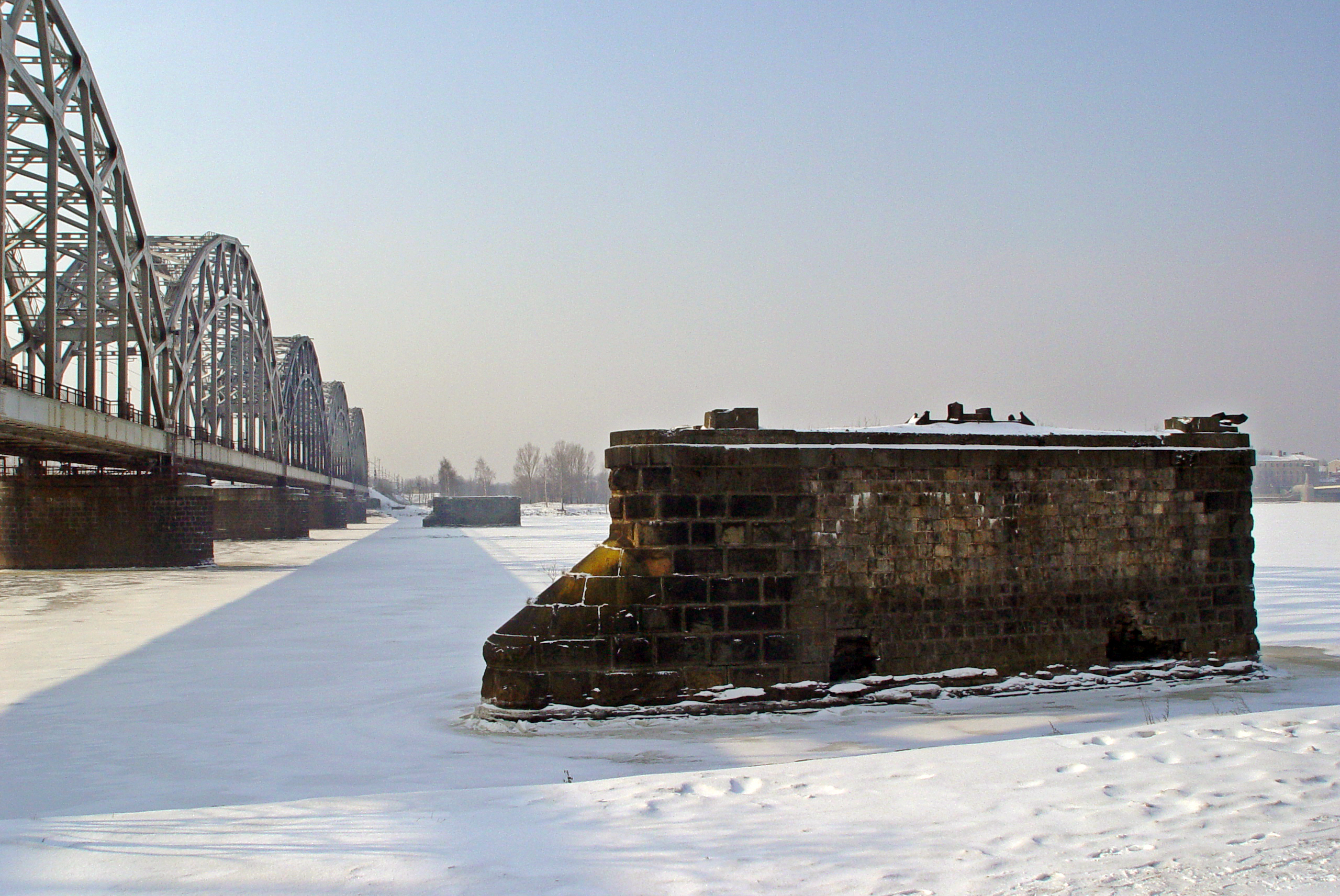
The only remains of the bridge are its pillars in the river.