New Lanark est un village situé au bord de la Clyde, à environ deux kilomètres du Royal Burgh de Lanark, dans le South Lanarkshire en Écosse. Il fut fondé en 1785 par David Dale (1739-1806), qui y fit construire des usines de coton et des résidences pour les ouvriers. Dale choisit cet endroit pour profiter de l'énergie hydraulique offerte par la rivière. Sous la direction de Dale puis de son gendre philanthrope et socialiste réformiste, Robert Owen (1771-1858), les usines prospérèrent et New Lanark devint un exemple de socialisme utopique. Les usines de New Lanark continuèrent de fonctionner jusqu'en 1968. Après une période de déclin, le New Lanark Conservation Trust fut fondé en 1975 afin d'empêcher la démolition du village. Aujourd'hui, la plupart des bâtiments ont été restaurés et le village est devenu une attraction touristique importante. C'est également l'un des six sites d'Écosse reconnus comme patrimoine mondial par l'UNESCO.

Nearby Places View Menu
Location Image
410 m

New Lanark

New Lanark is a village on the River Clyde, approximately 1.4 miles (2.3 kilometres) from Lanark, in Lanarkshire, and some 25 miles (40 km) southeast of Glasgow, Scotland. It was founded in 1785 and opened in 1786 by David Dale, who built cotton mills and housing for the mill workers. Dale built the mills there in a brief partnership with the English inventor and entrepreneur Richard Arkwright to take advantage of the water power provided by the only waterfalls on the River Clyde. Under the ownership of a partnership that included Dale's son-in-law, Robert Owen, a Welsh utopian socialist and philanthropist, New Lanark became a successful business and an early example of a planned settlement and so an important milestone in the historical development of urban planning. The New Lanark mills operated until 1968. After a period of decline, the New Lanark Conservation Trust (NLCT; now known as the New Lanark Trust, NLT) was founded in 1974, to prevent demolition of the village. By 2006 most of the buildings had been restored and the village has become a major tourist attraction. It is one of seven UNESCO World Heritage Sites in Scotland and an Anchor Point of ERIH – the European Route of Industrial Heritage.
Location Image
584 m

Corehouse

Corehouse is a country house and estate, located 2 kilometres (1.2 mi) to the south of Lanark, Scotland. The estate is by the Corra Linn Falls on the River Clyde, and close to the World Heritage Site of New Lanark. The house was designed by Sir Edward Blore for George Cranstoun, Lord Corehouse, and was completed in 1827.
742 m

Bonnington Pavilion

The Bonnington Pavilion or Hall of Mirrors, now a ruin, is situated in the grounds of the old estate of Bonnington, near New Lanark, overlooking Corra Linn falls on the River Clyde in Lanarkshire, Scotland. Alternative names are the Corra Linn Pavilion and the Falls of Clyde summerhouse. It is said to have been the first Camera obscura built in Scotland. The name comes from the Gaelic 'currach', a marshy place. A legend gives 'Cora' as a daughter of King Malcolm II, who leapt to her death here whilst trying to escape imagined danger.
Location Image
746 m

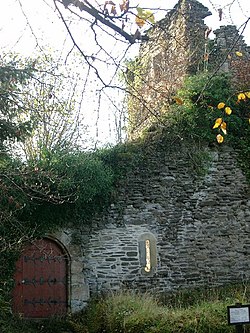
Corra Castle

Corra Castle (also known as Corrax, Corax or Corehouse Castle) is a ruined 16th-century castle within the Corehouse Estate near New Lanark, Scotland. It overlooks Corra Linn, one of the four waterfalls which make up the Falls of Clyde. In 1967 it became a scheduled monument. The site was chosen because it was seen as being impregnable, as it is surrounded by sharp cliffs on three sides. It features a ha-ha as part of its design, offering an unobstructed view of the surrounding countryside. Corra Castle was at one time the residence to one of the branches of the notable family of Somerville. In his 1832 book, The Edinburgh Encyclopædia, David Brewster wrote: ...and directly above the upper fall, stands the ruinous castle of Corra, formerly the residence of a family of the name of Somerville...
Location Image
770 m

Falls of Clyde (waterfalls)

The Falls of Clyde are a series of linns or waterfalls on the River Clyde, near Lanark, Scotland. They are renowned for their beauty and have frequently been painted by artists. There are four in total: Bonnington Linn, Corra Linn, and Dundaff Linn, all above Lanark, and Stonebyres Linn, some distance below the town. The highest and most impressive of the four is Corra Linn, with a fall of 84 feet (26 m).