

 English
 Français
Bonnington Pavilion
The Bonnington Pavilion or Hall of Mirrors, now a ruin, is situated in the grounds of the old estate of Bonnington, near New Lanark, overlooking Corra Linn falls on the River Clyde in Lanarkshire, Scotland. Alternative names are the Corra Linn Pavilion and the Falls of Clyde summerhouse. It is said to have been the first Camera obscura built in Scotland. The name comes from the Gaelic 'currach', a marshy place. A legend gives 'Cora' as a daughter of King Malcolm II, who leapt to her death here whilst trying to escape imagined danger.
Nearby Places View Menu

152 m
Falls of Clyde (waterfalls)
The Falls of Clyde are a series of linns or waterfalls on the River Clyde, near Lanark, Scotland. They are renowned for their beauty and have frequently been painted by artists. There are four in total: Bonnington Linn, Corra Linn, and Dundaff Linn, all above Lanark, and Stonebyres Linn, some distance below the town. The highest and most impressive of the four is Corra Linn, with a fall of 84 feet (26 m).

208 m
Lanark Hydro Electric Scheme
The Lanark Hydro Electric Scheme consists of two hydroelectric plants in the Clydesdale area of South Lanarkshire, Scotland. They are run-of-the-river power stations, using water from the River Clyde near to the Falls of Clyde. Bonnington Power Station gets its water supply from just above Corra Linn in New Lanark, while Stonebyres Power Station takes water from above Stonebyres Linn near Kirkfieldbank. Bonnington is the larger of the two stations, which between them can produce 17 MW.
The Lanark Hydro Electric Scheme was the first large-scale scheme in the United Kingdom to produce clean renewable energy for public supply, using water from the Falls of Clyde to power homes and meet the growing demand for electricity after World War I. The scheme does not use dams for water storage, relying instead on there being sufficient water in the river and flowing down the waterfalls to enable the power stations to operate for most of the year. The two stations generate enough electricity for power over 17,000 homes, and make a significant contribution to the target of producing 40 per cent of Scotland's energy from renewable sources by 2020.

221 m
Corehouse
Corehouse is a country house and estate, located 2 kilometres (1.2 mi) to the south of Lanark, Scotland. The estate is by the Corra Linn Falls on the River Clyde, and close to the World Heritage Site of New Lanark. The house was designed by Sir Edward Blore for George Cranstoun, Lord Corehouse, and was completed in 1827.
221 m
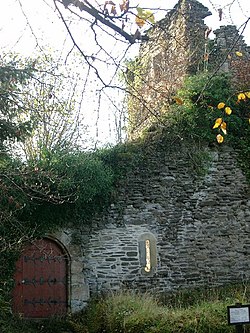
Corra Castle
Corra Castle (also known as Corrax, Corax or Corehouse Castle) is a ruined 16th-century castle within the Corehouse Estate near New Lanark, Scotland. It overlooks Corra Linn, one of the four waterfalls which make up the Falls of Clyde. In 1967 it became a scheduled monument.
The site was chosen because it was seen as being impregnable, as it is surrounded by sharp cliffs on three sides. It features a ha-ha as part of its design, offering an unobstructed view of the surrounding countryside.
Corra Castle was at one time the residence to one of the branches of the notable family of Somerville. In his 1832 book, The Edinburgh Encyclopædia, David Brewster wrote:
...and directly above the upper fall, stands the ruinous castle of Corra, formerly the residence of a family of the name of Somerville...