

 English
 Français

Holy Trinity Church, Micklegate, York is a Grade I listed parish church in the Church of England in York.
Nearby Places View Menu
12 m
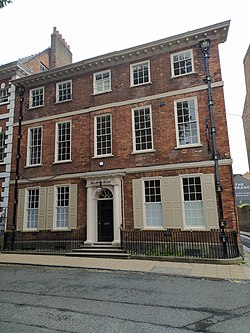
Bathurst House
Bathurst House is a historic building in the city of York, in England. Grade II* listed and standing at 86 Micklegate, part of the building dates to around 1727; it was made into three storeys around 1822. The iron railings at the front of the property are part of the listing.
The property was built for Charles and Frances Bathurst. Upon Frances' death, she was buried in the church of St Martin-cum-Gregory across the street. Her tombstone stated she was "a person of excellent accomplishments both of body and mind, and adorned the several stations of life she went through".
From 1872 to 1879 it was used as offices for a District Goods Manager of the North Eastern Railway Company. Then it became the business premises of Grays, a musical instrument dealer.
It became a hotel between 1911 and 1921, then York YWCA. The University of York owned it in the 1960s, before it became the home of Barron and Barron, chartered accountants, having sold for £1 million in 2017.

18 m
Micklegate House
Micklegate House is a Grade I listed building in York, a city in England.
The house lies on Micklegate, in the city centre. It was completed by 1752, as a town house for John Bourchier of Beningbrough Hall. It is often said to have been designed by John Carr, a local architect, as it is similar to other designs by him, although there is no firm evidence of this attribution.
Bourchier died in 1759, and the house passed to his wife. When she died, in 1796, it was leased to James Walker, then to Joshua Crompton, who bought the freehold in 1815 and whose descendants lived in the property until 1896. The house was then used as business premises, and many of the fittings were sold, most of the best being moved to Treasurer's House.
The house is the largest on the street, three stories high and seven bays wide. The front is of red brick, with stone dressings, and the rear of pink brick. Some original sash windows survive, as do a fireplace and bread oven on the second floor. The hall retains rich decoration and a grand staircase to the first floor, and the dining room and library on the ground floor also retain some original fittings.
The house was listed in 1954, along with its railings and lamp brackets. The house was used by the University of York. In the 1960s it housed the Department of Mathematics, while from 1978-1996 it housed the Department of Archaeology before it moved to King's Manor. In 2015, it was converted into the Safestay hostel.

34 m
The Falcon, York
The Falcon is a historic pub on Micklegate in the city centre of York, in England.
The establishment originated as an inn named The Falcon, in the 18th-century. It was first recorded in 1715, and in 1736, Francis Drake named it one of two notable inns on the street. In 1818, William Hargrove described it as the most notable inn on the road. Its site stretched back to Tanner Row, where its stables were located. With the opening of York railway station, the stagecoach trade declined, and the inn struggled. In 1842 and 1843, the site was redeveloped, being divided between a smaller pub (now 94 Micklegate) and a neighbouring house (now 96 Micklegate). The only surviving feature of the inn was a gilded carved figure of a falcon, acting as a pub sign.
The Victorian buildings are of three storeys and an attic, and largely original sash windows above the ground floor. The pub also has a bay window on the first floor. There is a substantial cornice above the second floor. Inside, 96 Micklegate retains an original staircase, but the property has been converted into a shop. Since 1971, the pair of buildings has been Grade II listed.
In 1981, a new cellar was added underneath the rear yard of the Falcon. In 2002, the pub was converted into a bar named "Rumours". However, in 2014 it returned to operating as a pub, under the name The Falcon Tap, and the original cellar was reopened. In 2017, permission was received to demolish modern rear extensions, and replace them with nine flats, and two more on the upper floors of the main building, while also halving the area of the bar. By 2018, it was listed in the Good Beer Guide.
In 2018, it was purchased by Almero Holdings and closed unexpectedly for conversion into an aparthotel, intending to retain the pub on the ground floor. In 2022, it reopened, as "The Falcon", run by the owners of the Turning Point Brewery.

40 m
Micklegate
Micklegate is a street in the City of York, England. The name means "Great Street", from the Old Norse gata for street.
Micklegate is described by York City Council as "one of the most handsome streets in Yorkshire", and was described by Nikolaus Pevsner as "...without any doubt the most architecturally rewarding street in York". The street contains three medieval churches and four Grade I listed buildings. Most buildings are three- or four-storey Georgian structures.
The name Micklegate is sometimes applied to a slightly broader area, including the side streets Toft Green, Priory Street, Trinity Lane and St Martin's Lane. The Micklegate ward for elections to the City Council covers a larger area, spreading beyond the city walls.