Location Image

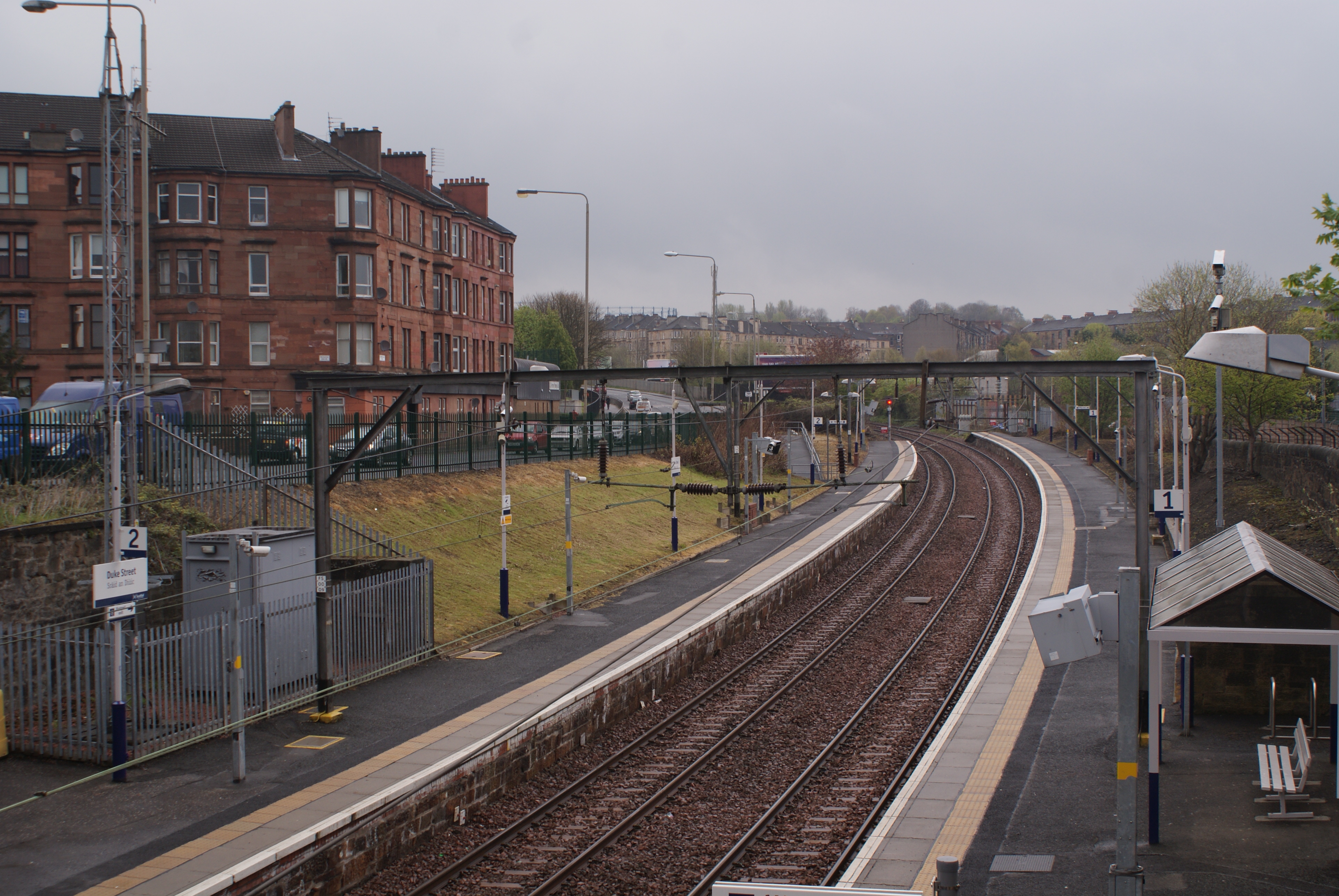
Duke Street railway station

Duke Street Railway Station is a railway station in Glasgow, Scotland. The station is managed by ScotRail and is served by trains on the North Clyde Line, 1½ miles (2 km) north east of Glasgow Queen Street. It was built as part of the City of Glasgow Union Railway which provided a link across the Clyde (between the Glasgow and Paisley Joint Railway at Shields Junction and the Edinburgh and Glasgow Railway at Sighthill Junction). Though goods traffic began using the line in 1875, the station was not opened until 1881 with trains initially running as far as Alexandra Park (as it was then known). An extension to Barnhill followed two years later, but it was not until 1887 that they finally reached Springburn. Electric operation at the station began in 1960 (using the 25 kV A.C overhead system), when the branch from Bellgrove was incorporated into the North Clyde line electrification scheme. Through running to Cumbernauld began in May 2014 - prior to this a change at Springburn was required.

Nearby Places View Menu
212 m

Whitehill Secondary School

Whitehill Secondary School (formerly Whitehill Senior Secondary School) is a Scottish non-denominational comprehensive secondary school located in the suburb of Dennistoun in Glasgow. The school is a part of the Whitehill Campus, along with Golfhill Primary School and Westercraigs Nursery. The campus was assembled in 2007, following the closure of the Golfhill Primary building due to structural issues. The school moved into the main building in 2009, with Westercraigs having their own structure.
Location Image
322 m

Dennistoun

Dennistoun () is a mostly residential district in Glasgow, Scotland, located north of the River Clyde and in the city's east end, about 1+1⁄4 miles (2 kilometres) east of the city centre. Since 2017 it has formed the core of a Dennistoun ward under Glasgow City Council, having previously been a component of the East Centre ward. Aside from the smaller Haghill neighbourhood further east, Dennistoun's built environment does not adjoin any others directly, with the M8 motorway dividing it from Royston to the north, while the buildings of Glasgow Royal Infirmary and Wellpark Brewery plus the Glasgow Necropolis cemetery lie to the west (separating it from adjacent Townhead), and railway lines form the southern boundary with the Calton/Gallowgate neighbourhoods, and Camlachie (a historic district which is now largely a retail park) on the opposite side.
Location Image
344 m

Greencity Wholefoods

Greencity Wholefoods is a worker co-operative wholefoods wholesaler in Glasgow, Scotland. The co-operative was founded in 1978 in Hillington, in the outskirts of Glasgow before moving in 1983 to its current location in Dennistoun in the city's East End. In 2019 the co-operative reported an annual turnover of £7.7 million and has 54 employee-members. As a worker co-operative the business is directly owned and controlled by its workers through a directly elected management committee and quarterly general meetings. The co-operative operates a flat wage structure, with every member paid the same hourly wage, alongside a flat management structure and a system of rotating the co-operative's directly elected managers. Greencity has many similarities with Suma, a worker co-operative in West Yorkshire, and stocks many Suma brand products. The co-operative delivers goods across Scotland, except for the Highlands and Islands which are covered by Greencity's sister co-operative Highland Wholefoods Workers Co-operative which Greencity helped establish in 1989.
Location Image
383 m

Bluevale and Whitevale Towers

The Bluevale and Whitevale Towers were twin 31–storey brutalist tower block flats situated in the Camlachie district within the East End of Glasgow, Scotland. Both towers contained 31 floors, and were the second highest public housing schemes in the United Kingdom behind the Barbican Estate in London. Officially named 109 Bluevale Street and 51 Whitevale Street, and often nicknamed the Gallowgate Twins or the Camlachie Twin Towers, the two towers were for a time the tallest buildings in Scotland. After originally being condemned in 2011, in early 2016 the demolition of both towers was completed.