

 English
 Français

Purey-Cust Lodge
Purey-Cust Lodge is a historic building in the English city of York, North Yorkshire. Now Grade II listed, it dates to 1845. Prior to this date, it was the site of York Minster Stoneyard. The building is named for Arthur Purey-Cust, who served as Dean of York from 1880 to 1916. Its southern wall makes up part of the western end of Precentor's Court, a mediaeval cul-de-sac. At the eastern end of that street is the gate to and from the former gardens of the lodge. The gate used to open onto the minster stoneyard, in the shadow of York Minster.
Nearby Places View Menu
22 m
5 Precentor's Court
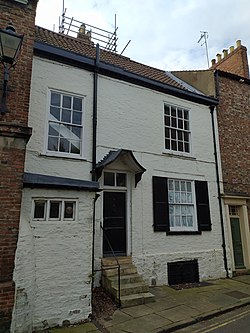
5 Precentor's Court is a historic building in the English city of York, North Yorkshire. A Grade II* listed building, standing on Precentor's Court, it dates to the early 18th century.
Architect Henry Cane was living at the property in 1872, while James Boyd, a licensed preacher in the diocese of York, lived there in the early 20th century.

23 m
10 Precentor's Court
10 Precentor's Court is a historic building in the city of York, North Yorkshire, England.
The building is Grade II* listed, standing on Precentor's Court and is perpendicular to Fenton House at the western end of the street.
Parts of the house date to the 15th century: stone walls on three sides of the building, and in the entrance hall, the arch of a fireplace. The remainder of that house was demolished in the early 18th century, when the present building was constructed, with a new brick facade facing Precentor's Court. The building was altered internally in the mid-19th century, when a bay was added to the rear. In about 1900, the north-west wing of the house was entirely rebuilt, and the roof of the building was raised, adding an attic.
Inside the house, in the ground floor study, there are 16th-century beams, 17th-century panelling, and an 18th-century fireplace. The staircase is early-18th century but has been rebuilt, while the north-east bedroom has an 18th-century fireplace, moved from elsewhere.
The gates and railings in front of the house are Grade II listed.
Reverend George Addleshaw (1906–1982) lived at the property in 1952.

23 m
6–7 Precentor's Court
6 and 7 Precentor's Court are an historic pair of buildings in the English city of York, North Yorkshire. Grade II listed and standing on Precentor's Court, the buildings date to the mid-19th century, with No. 7 having earlier origins. The properties were renovated in the 20th century.
Rachael Epworth, a pawnbroker, formerly lived at the property. Henry Hardcastle purchased the property from her. A. Ayer Carr, a new member of the Yorkshire Philosophical Society, was living at No. 6 in 1900.
6 Precentor's Court was used as the exterior filming location for the home of the lead character Patience Evans in the television drama Patience.

29 m
Precentor's Court
Precentor's Court is a historic street in the English city of York. Although certainly in existence by 1313, the street does not appear on a map until 1610, and it is not given a name (Precentor's Lane) until 1722. It was given its current name exactly a century later.
It is a cul-de-sac, running northwest from High Petergate at the western end of York Minster, in front of which the road apexes. A snickelway, known as Little Peculiar Lane, cuts through to the street, at its western end, from High Petergate.
The frontages on High Petergate were developed with commercial properties for letting. A new lane, today's Precentor's Court, was developed, dividing these commercial properties from the canons' residences to the rear.
Around 1540, the marble and stone bases of two shrines in the Minster were dismantled and buried in what is now Precentor's Court. One was later exhumed during construction work and is now preserved in the Yorkshire Museum.
The street was home to St Stephen's orphanage from 1870 to 1872, when it moved to Trinity Lane.